Encyclopedia

Designing artificial intelligence (and everything else)

A new documentary “Do You Trust This Computer?” is out there, covering much of the newest e-tourism trends. This is how its authors are intriguing the audience: “Science fiction has long anticipated the rise of machine intelligence. Today, a new generation of self-learning computers has begun to reshape every aspect of our lives. Incomprehensible amounts of data are being created, interpreted, and fed back to us in a tsunami of apps, personal assistants, smart devices, and targeted advertisements. Virtually every industry on earth is experiencing this transformation, from job automation, to medical diagnostics, even military operations. Do You Trust This Computer? explores the promises and perils of our new era. Will A.I. usher in an age of unprecedented potential, or prove to be our final invention?”

But Michael Jordan from UC Berkeley releases the throttle, arguing that The Revolution Hasn’t Happened Yet. Firstly, “Most of what is being called “AI” today, particularly in the public sphere, is what has been called “Machine Learning” (ML) for the past several decades. ML is an algorithmic field that blends ideas from statistics, computer science and many other disciplines (see article link for detailed explanations) to design algorithms that process data, make predictions and help make decisions.” 

Jordan continues there are other, more human- and less tech-related issues opened currently: “We need to realize that the current public dialog on AI — which focuses on a narrow subset of industry and a narrow subset of academia — risks blinding us to the challenges and opportunities that are presented by the full scope of AI, IA and II[i]. This scope is less about the realization of science-fiction dreams or nightmares of super-human machines, and more about the need for humans to understand and shape technology as it becomes ever more present and influential in their daily lives. Moreover, in this understanding and shaping there is a need for a diverse set of voices from all walks of life, not merely a dialog among the technologically attuned.” And: ” In the current era, we have a real opportunity to conceive of something historically new — a human-centric engineering discipline.”


[i] “Intelligence Augmentation” (IA) and “Intelligent Infrastructure” (II). See Jordan’s paper for the explanation.

Designing artificial intelligence (and everything else) Read More »

Building a team of innovative problem-solvers

What makes an efficient innovating team who will wisely sail through the complex and highly disruptive waters of tourism and any other discipline? 
 
In his thoughts on “Ways to Develop Problem-Solving Teams” Jeff Pruitt suggests these three tactics:
  • Develop cognitive diversity
  • Ensure psychological safety
  • Cut out complexity
But Eric Berridge goes much further – in the TED Talk “Why tech needs the humanities“:
 

Building a team of innovative problem-solvers Read More »

Four ways that design can contribute to tourism innovation

Bruce Wan, School of Design, the Hong Kong Polytechnic University

HOW TO CITE:

Wan, B. (2020). Four ways that design can contribute to tourism innovation. In AIRTH Encyclopedia of Innovation in Tourism and Hospitality. Retrieved: , from http://www.airth.global

Introduction

Although the concept of innovation has been around in the tourism industry for long, yet, little is known about a clear guide on how to achieve innovativeness in the industry. Even more interesting is the fact that the incorporation of design thinking and processes which informs radical innovative ideas[1] is yet to gain grounds in tourism research. A well-known example of an innovative idea eluding industry practitioners and academic researchers is the breakthrough created by the sharing economy. Against this backdrop, four ways in which design thinking can facilitate tourism innovation are proposed: (1) provision of a knowledge base that supports design decision-making, (2) aligning the roles of the design team with the design process, (3) the use of design methods that facilitate innovation, and (4) through design outcomes of idea development and communication. 

Figure 1. Design thinking within the double diamond model (Adapted from[2]).

Relevance for tourism innovation

As a first step, a knowledge base that supports design decision making is required. Informed decision-making entails that the design team establish mutual understanding and agreement regarding the knowledge at hand. Although a design decision can certainly be made based on explicit knowledge, research has also found tacit knowledge to be a great source of creative power that can lead to disruptive innovation[3]. With the increasing interest in exploring design practices specific to tourism[4], it is suggested that the generation of tacit knowledge about tourism innovation via a learning-by-doing process can be realised by implementing design thinking (i.e., design process and methods) in the curricula of tourism education or in companies.

Secondly, it is important to understand the different roles the design team members should play in the design process. This is especially as design thinking involves the cognitive, strategic and practical methods that designers and design teams use throughout their design investigation processes to generate outcomes that satisfy design goals or questions[5]. Hence, adherence to participatory design principles and the active engagement of end-users and experts from the tourism and hospitality industries are expected. Since the design process involves a range of activities, such as field study, observation, ideation, and prototyping; clarifying the roles of the designer, design team members, and participants will facilitate the implementation of tourism innovations.

Thirdly, Design investigation requires that the design team master various design methods. There is an abundance of “generic” design methods[6] to help a design team advance through the stages of the design process. However, a design team with diverse backgrounds can easily become overwhelmed by the multiplicity of these tools. Furthermore, the tools may be too generic and thus ineffective in producing valuable outcomes. Therefore, design and tourism researchers should curate a collection of design methods to create new tools (for instance, tourism hackathon) specific to the industry for tourism innovation.

Lastly, design outcomes refer to the artefacts produced by the design team throughout the whole design process. Two types of outcome can be produced: those that are a result of design investigation, and those produced for the purpose of communication[7]. The findings of the former can be incorporated into the latter, which can then be used as explicit knowledge for communicating design concepts. These design outcomes can be presented in both textual and visual formats. Developing explicit knowledge about these artefacts can contribute significantly to tourism innovation because they are the essence of the success or failure of the innovation.

Wrap-up

Although innovation is a driving force in tourism development and has been transforming the industry since the last century, innovation research in tourism is still in its infancy. There is also an apparent gap in design-thinking research with respect to its application to tourism innovation. Thus, implementing design thinking in tourism can help researchers and industry players to identify the processes and conditions that contribute to successful tourism innovation. This article highlighted four areas in which design and tourism researchers can work together toward the advancement of the tourism industry.


[1] Fesenmaier, D. R., & Xiang, Z. (Eds.). (2017). Design science in tourism. Cham: Springer International Publishing. https://doi.org/10.1007/978-3-319-42773-7

[2] Design Council. (2005). A study of the design process. Design Council44(0), 1–144.

[3] Leonard, D., & Sensiper, S. (1998). The role of tacit knowledge in group innovation. California Management Review40(3), 112–132. https://doi.org/10.2307/41165946

[4] Egger, R., Gula, I., & Walcher, D. (Eds.). (2016). Open tourism. Berlin, Heidelberg: Springer Berlin Heidelberg. https://doi.org/10.1007/978-3-642-54089-9

[5] Dorst, K. (2011). The core of “design thinking” and its application. Design Studies32(6), 521–532. https://doi.org/10.1016/j.destud.2011.07.006

[6] Kumar, V. (2013). 101 Design methods: A structured approach for driving innovation in your organization. Hoboken, N.J.: Wiley.

[7] Cooper, R., Junginger, S., & Lockwood, T. (2009). Design thinking and design management: A research and practice perspective. Design Management Review20(2), 46–55. https://doi.org/10.1111/j.1948-7169.2009.00007.


Four ways that design can contribute to tourism innovation Read More »

The evaluation of innovation

Dejan Križaj, AIRTH and University of Primorska, Faculty of Tourism Studies – Turistica 

HOW TO CITE:

Križaj, D. (2020). The evaluation of innovation. In AIRTH Encyclopedia of Innovation in Tourism and Hospitality. Retrieved: <insert-date>, from http://www.airth.global


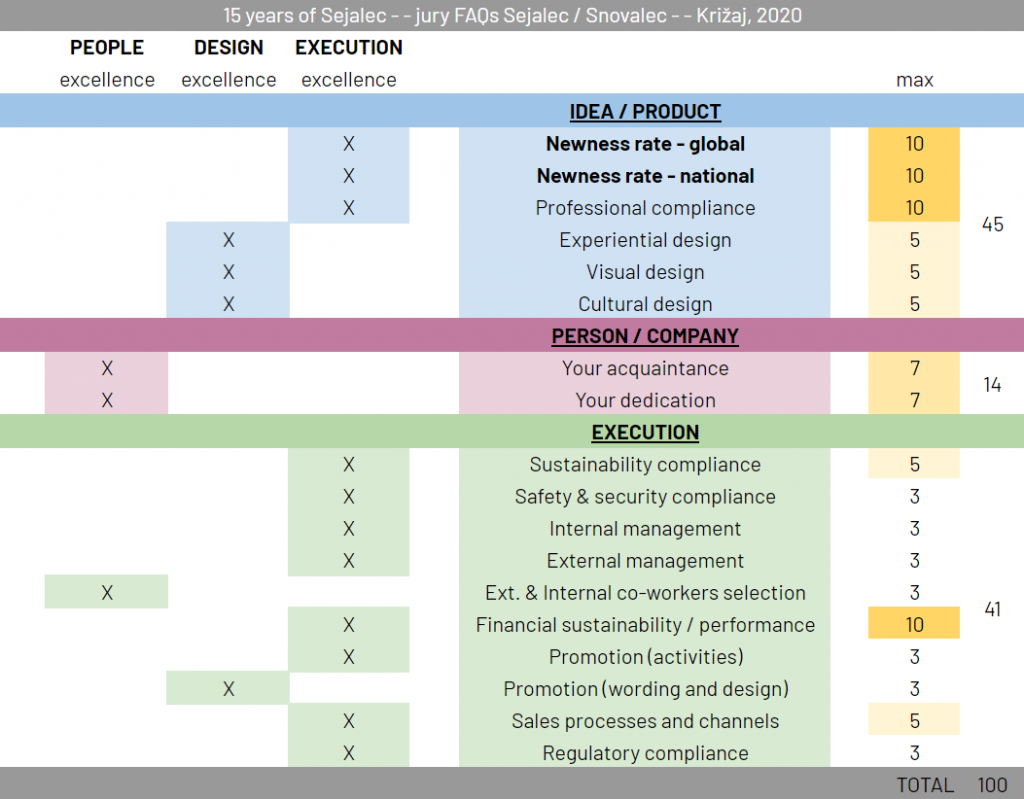
In the role of the head of the expert commission for national tourism innovation awards Sejalec and Snovalec from 2006 onward, I collected and categorized the standard FAQs on which the authors of the evaluated ideas and products are usually interviewed. The estimated weights are added based on my opinion of how important each question is to the jury members.
 
This list is accompanied by already available links to other parts of the AIRTH Encyclopedia addressing these questions. Expect more links to be added as the Encyclopedia grows further 🙂
 
In the attached table you can see how the listed FAQs/attributes are matched with the PEOPLE / DESIGN / EXECUTION excellence categories.

IDEA / PRODUCT

Newness rate – global: How new is the idea on a global level?
Newness rate – national: How new is the idea on a national level?
Professional compliance: Is it done the way top experts (in the field) would do it?
Experiential design: Is the experience designed as smooth and engaging as possible?
Visual design: Is the idea/product presented according to the latest design guidelines?
Cultural design: Is the idea/product designed with local tangible & intangible, past & current, cultural aspects and their preservation in mind?
 

PERSON / COMPANY

Your acquaintance: How experienced are you?
Your dedication: How committed are you?
 

EXECUTION

Sustainability compliance: Is sustainability covered from all angles?
Safety & security compliance: Is safety/security covered from all angles?
Internal management: How does the team/company function internally?
External management: How does the team/company function externally?
Ext. & Internal co-workers selection: Are all the co-workers top notch?
Financial sustainability / performance: Is the idea/product financially viable/sustainable?
Advertising (activities): Are the advertising activities well thought and effective?
Advertising (formulation and design): Is the use of marketing language and design appropriate and effective?
Sales processes and channels: Is the idea/product distributed and sold efficiently?
Regulatory compliance: Do the idea/product and undelying procedures follow all regulations?

The evaluation of innovation Read More »

The process of innovation

Isabel Rodriguez, University of Surrey

HOW TO CITE:

Rodriguez, I. (2018). The process of innovation. In AIRTH Encyclopedia of Innovation in Tourism and Hospitality. Retrieved: , from http://www.airth.global 

Introduction

Innovation is often thought as an outcome; however, the innovation process, or how innovations are developed and implemented over time[i], has tended to be and still largely is a ‘black box’, whose complex internal workings are poorly understood[ii].  This knowledge gap is especially acute in tourism.

Theories and models, especially from the 80s based on manufacturing and studying successful intrapreneurs within major corporations have traditionally given an oversimplified image of the innovation process as linear and formed by a predictable sequence of stages[iii] [iv]. According to Schroeder et al. (1986)1, stage models were too simplistic to explain complex innovation processes and subsequent literature would characterize the innovation process as inherently dynamic[v], uncertain[vi], random and slightly chaotic[vii] [viii] with unpredictable delays and setbacks.

During the innovation journey, entrepreneurs engage in a sequence of events that transform a new idea into an implemented reality4. According to Kanter[ix], these broadly correspond to the unfolding innovation process: idea generation, coalition building, idea realization and transfer or diffusion. The time-order of the tasks described below, however, is non-linear.

Idea generation

Innovation begins with entrepreneurs who sense a new opportunity which is then repeatedly evaluated engaging with informed individuals, doing a preliminary market testing or financial viability analysis, etc.   

Coalition building

This task involves power acquisition by bringing potential allies into the process. The sources of power can consist of knowledge, finance, time and space resources, or support in the form of backing or approval.

Idea realization

This task involves turning the idea into something tangible, such as a prototype. There are also critical organizational challenges. In start-ups, this task not only gives rise to the innovation but also the entire business.

Transfer or diffusion

The innovation process culminates with the commercialization or the adoption of the innovation by users. Customer adoption will determine the success or failure of the innovations.

Relevance for tourism innovation research

Rodriguez et al. (2017) have studied the innovation process of a sample of tourism entrepreneurs and the finding both confirm and challenge existing ideas about the innovation process in the field of tourism. The innovation process in tourism is especially dynamic and agile with customer interaction being integral[x].  The study empirically provides confirmation that the process does not follow the linear stages of existing traditional models which describe innovation in already established manufacturing firms (e.g. Stage Model of Cooper or Kanter’s model). The start-up process analyzed has more agile dynamics in which a product or service – even if not necessarily fully developed – is quickly and constantly evaluated and adapted to the market (see Figure 1 below). Knowledge is not incorporated through deep formal initial research but progressively through experimentation. This Doing, Using and Interacting experienced-based mode of learning[xi] has also been noted by Nordin and Hjalager[xii] in their Icehotel innovation case study and seems to be appropriate to the tourism sector. User-driven and agile innovation approaches or methods which have gained progressive importance (e.g. Lean Startup) are inspiring new practices which require rethinking existing frameworks especially when dealing with more innovative projects[xiii]. To accelerate the process, many activities overlap rather than forming a neat, orderly sequence. This is especially evident in the constant evaluation and coalition building over time with different key stakeholders. Evaluation is critical to guiding this process, with learning and flexible modification of the existing path. This work also challenges some assumptions. For example, Kanter (1983, 1988) considered that coalition building was the second task of the process however in the tourism sample analyzed this was a transversal and continuous task throughout the journey.

The heterogeneity and the contingent nature of the innovation process mean that caution is required with respect to generalization and extrapolation of this study’s findings: the results are context-dependent, and the sample selection involves specific types of entrepreneurs and innovations, and is tied to the development of a start-up. The innovation process is also affected by the context (cultural, political and institutional) and might differ in other tourism innovation journeys (e.g. less technological forms of innovation, more complex, R&D intensive and higher risk projects), and this need to be analyzed.

Figure 1. A model of the innovation process based on the study of a sample of innovative tourism entrepreneurs


[i] Schroeder, R., Van de Ven, A., Scudder, G., & Polley, D. (1986). Managing innovation and change processes: findings from the Minnesota Innovation Research Programme. Agribusiness, 2(4), 501-523.

[ii] Garud, R., Tuertscher, P., & Van de Ven, A. H. (2013). Perspectives on innovation processes. The Academy of Management Annals, 7(1), 775-819. http://doi.org/10.1080/19416520.2013.791066

[iii] Cooper, R. (1994). Third generation new product processes. Journal of Product Innovation Management11(1), 3-14. http://doi.org/10.1016/0737-6782(94)90115-5

[iv] Van de Ven, A., Polley, D., Garud, R., & Venkataraman, S. (1999). The innovation journey. New York: Oxford University Press.

[v] Kline, S. J., & Rosenberg, H. (1986). An overview of innovation. In R. Landau & R. Rosenberg (Eds.), The positive Sum Game (pp. 275-305). Washington DC: National Academy Press.

[vi] Kanter, R. M. (1983). The Change Masters. London: Unwin.

[vii] Quinn, J. (1985). Managing innovation: Controlled chaos. Harvard Business Review63(3), 73-84. http://doi.org/10.2139/ssrn.1504499

[viii] Tushman, M., & Anderson, A. (1986). Technological discontinuities and organizational environment. Administrative Science Quarterly31(3), 436-465. http://doi.org/10.2307/2392832

[ix] Kanter, R. M. (1988). When a thousand flowers bloom: structural, collective, and social conditions for innovation in organisations. In L. L. Cumming (Ed.), Research in organizational behavior (pp. 169–211). Greenwich, CT: JAI Press

[x] Hjalager, A. M. (2010). A review of innovation research on tourism. Tourism Management31, 1-12. http://doi.org/10.1016/j.tourman.2009.08.012

[xi] Jensen, M. B., Johnson, B., Lorenz, E., & Lundvall, B. Å. (2007). Forms of knowledge and modes of innovation. Research policy, 36(5), 680-693. http://doi.org/10.1016/j.respol.2007.01.006

[xii] Nordin, S., & Hjalager, A. (2017). Doing, Using, Interacting: Towards a New Understanding of Tourism Innovation Processes. In A. Kiráľová (Ed.), Driving Tourism through Creative Destinations and Activities (pp. 165-180). Hershey, PA: IGI Global.

[xiii] Cooper, R. G. (2016). Agile–Stage-Gate Hybrids. Research-Technology Management, 59(1), 21-29. http://dx.doi.org/10.1080/08956308.2016.1117317

The process of innovation Read More »

Schumpeter’s Theory of Economic Development

One of the fathers of modern innovation theories is the political economist Joseph A. Schumpeter (1883-1950). Here are a few basic notes about his contributions from the two sources:
 
EconomicsDiscussion.net
 
 
The following points highlight the four important features of Schumpeter’s theory of economic development.
 
“Feature # 1. Circular Flow:
Schumpeter starts his analysis of development process with the concept of circular flow. It implies a condition where economic activity produces itself continuously at constant rate through time.”
 
“Feature # 2. Role of the Entrepreneur:
Entrepreneur or innovator is the key figure in Schumpeter analysis of the process of development. He occupies the central place in the development process because he initiates development in a society and carries it forward. Entrepreneurship is different from managerial activity.”
 
“Feature # 3. Business Cycle or Cyclical Process:
The next component of development according to Schumpeter is the business cycle. Schumpeter’s approach to business cycle or crisis is historical, statistical and analytical. He believes that business cycle or crisis is not merely the result of economic factors but also of non-economic factors. Schumpeter concludes that crisis is the “process by which economic life adapts itself to the new economic conditions”.”
 
“Feature # 4. The Decay of Capitalism:
The continuous technical progress results in an unbounded increase in total and per capita output. As long as technological progress takes place, the rate of profit is positive. Hence, there can be no drying up of sources of investible funds nor any vanishing of investment opportunities.”
__
 
Where to go from here? In one of the interpretations Karol Sledzik elaborates “Schumpeter’s view on Innovation and Enterpreneruship” like this:
 
Academia.edu
 
 
“We are living in a complex and dynamic world in which innovation and entrepreneurship are occupying a decisive role for economic development. According to Joseph Alois Schumpeter “carrying out innovations is the only function which is fundamental in history”. He also accented that it is entrepreneurship that ”replaces today’s Pareto optimum with tomorrow’s different new thing”. Schumpeter’s words that entrepreneurship is innovation have never seemed so appropriate as the nowadays, when modern capitalism is experiencing a serious crisis and lost his strength during last subprime and euro-debt crises. The purpose of this paper is the analysis of the Schumpeter’s innovation concept in a context of “first” and “second” Entrepreneurship theory.”

Schumpeter’s Theory of Economic Development Read More »

Disruptive innovation

One of the more recent theories brings “disruptive warning” to organizations. Watch your back; and front! Two established sources describe these warnings as follows.

Harward Business Review

https://hbr.org/2015/12/what-is-disruptive-innovation

““Disruption” describes a process whereby a smaller company with fewer resources is able to successfully challenge established incumbent businesses. Specifically, as incumbents focus on improving their products and services for their most demanding (and usually most profitable) customers, they exceed the needs of some segments and ignore the needs of others. Entrants that prove disruptive begin by successfully targeting those overlooked segments, gaining a foothold by delivering more-suitable functionality—frequently at a lower price. Incumbents, chasing higher profitability in more-demanding segments, tend not to respond vigorously. Entrants then move upmarket, delivering the performance that incumbents’ mainstream customers require, while preserving the advantages that drove their early success. When mainstream customers start adopting the entrants’ offerings in volume, disruption has occurred.”

Clayton Christensen

http://www.claytonchristensen.com/key-concepts/

“Characteristics of disruptive businesses, at least in their initial stages, can include:  lower gross margins, smaller target markets, and simpler products and services that may not appear as attractive as existing solutions when compared against traditional performance metrics.  Because these lower tiers of the market offer lower gross margins, they are unattractive to other firms moving upward in the market, creating space at the bottom of the market for new disruptive competitors to emerge.”

Disruptive innovation Read More »

Diffusion of innovation theory

This is a well established general theory often used in tourism innovation research. Here are excerpts from two online sources that cover the topic in more detail:

Boston University

http://sphweb.bumc.bu.edu/otlt/MPH-Modules/SB/BehavioralChangeTheories/BehavioralChangeTheories4.html#headingtaglink_1

 
“Diffusion of Innovation (DOI) Theory, developed by E.M. Rogers in 1962, is one of the oldest social science theories. It originated in communication to explain how, over time, an idea or product gains momentum and diffuses (or spreads) through a specific population or social system. The end result of this diffusion is that people, as part of a social system, adopt a new idea, behavior, or product.   Adoption means that a person does something differently than what they had previously (i.e., purchase or use a new product, acquire and perform a new behavior, etc.). The key to adoption is that the person must perceive the idea, behavior, or product as new or innovative. It is through this that diffusion is possible.  
 
Adoption of a new idea, behavior, or product (i.e., “innovation”) does not happen simultaneously in a social system; rather it is a process whereby some people are more apt to adopt the innovation than others.   Researchers have found that people who adopt an innovation early have different characteristics than people who adopt an innovation later. When promoting an innovation to a target population, it is important to understand the characteristics of the target population that will help or hinder adoption of the innovation. There are five established adopter categories, and while the majority of the general population tends to fall in the middle categories, it is still necessary to understand the characteristics of the target population. When promoting an innovation, there are different strategies used to appeal to the different adopter categories.”
 
“The stages by which a person adopts an innovation, and whereby diffusion is accomplished, include awareness of the need for an innovation, decision to adopt (or reject) the innovation, initial use of the innovation to test it, and continued use of the innovation. There are five main factors that influence adoption of an innovation, and each of these factors is at play to a different extent in the five adopter categories.”
 
 
“Diffusion research examines how ideas are spread among groups of people.  Diffusion goes beyond the two-step flow theory, centering on the conditions that increase or decrease the likelihood that an innovation, a new idea, product or practice, will be adopted by members of a given culture.  In multi-step diffusion, the opinion leader still exerts a large influence on the behavior of individuals, called adopters, but there are also other intermediaries between the media and the audience’s decision-making.  One intermediary is the change agent, someone who encourages an opinion leader to adopt or reject an innovation (Infante, Rancer, & Womack, 1997). 
 
Innovations are not adopted by all individuals in a social system at the same time.  Instead, they tend to adopt in a time sequence, and can be classified into adopter categories based upon how long it takes for them to begin using the new idea.  Practically speaking, it’s very useful for a change agent to be able to identify which category certain individuals belong to, since the short-term goal of most change agents is to facilitate the adoption of an innovation.  Adoption of a new idea is caused by human interaction through interpersonal networks.  If the initial adopter of an innovation discusses it with two members of a given social system, and these two become adopters who pass the innovation along to two peers, and so on, the resulting distribution follows a binomial expansion.  Expect adopter distributions to follow a bell-shaped curve over time (Rogers, 1971).”

Diffusion of innovation theory Read More »

AIRTH’s take on 2020 travel trends

Every year different marketing agencies and consultancy companies compete with their predictions about the most significant trends for the coming year. This year, being also the beginning of a new decade, such lists are ever more prominent. So, to start an innovation-fuelled 2020, AIRTHers put their heads together in late December 2019 and early January 2020 and prepared our selection of top 5 trends that we believe will leave a mark in the travel industry of the 2020s. These include:
 
– Secondary cities: the interest in unknown destinations is growing. With over-tourism suffocating iconic destinations such as Venice, Barcelona, and Amsterdam, many travelers are more than ever willing to explore the “second-tier” destinations, even more so if visiting such cities contributes to the wellbeing of the locals and thus allows tourists to feel feel that they are the drivers of sustainable tourism change.
 
– Slow-motion: instead of looking for efficiency that dominates our working lives, many travelers will decide to take longer and more scenic routes to their destinations. This means preferring the “old-school” yet now also “sustainable” means of transport such as trains, boats, and even their own feet.
 
– Gastro-centric: you scroll your social media, get attracted by a particular dish that stimulates your imagination, and figure out who the chef behind it is. Next thing, you research where their restaurant is located, get a table confirmed in some months’ time, and bang there you go – this will be your next trip. Sounds familiar? Indeed it is one of highly likely travel scenarios of 2020s.
 
– Like a local: days when travelers just wanted to see the main sights of the destination are long gone. Now travel is about experiencing authentic places, sipping coffee in the hidden neighborhood cafes, and buying seasonal local produce from the small farmers’ markets that were up until now some of the best-kept secrets of local residents. Experiencing local culture and people watching are a must.
 
– Solo travel: a steeply growing segment, not only single millennials but even people above 45 in functional relationships, is pursuing solo travel to focus on particular interests. Tempting the solo traveler with an attractive and fairly-priced offer will become one of the big topics in travel marketing.

AIRTH’s take on 2020 travel trends Read More »

AIRTH’s take on 2021 signs of change

Miha BratecDejan KrižajJaka GodejšaTadej Rogelja – AIRTH & University of Primorska, Faculty of Tourism Studies, Turistica 


Introduction
 
While most people would agree that 2020 was the worst year in the modern history of tourism, and looking at the sheer numbers would confirm these claims, we at AIRTH will try to look beyond the obvious and offer a more balanced view of the lessons and trends that this pandemic helped triggering:
 

1. Overtourism is stopped and there is a real opportunity for sustainable change.

2. The high-spending, price-insensitive business segment is gone.

3. Flexible booking conditions are the (new) norm.

4. Consumer-centric services are needed more than ever.

5. Forced technology adoption is just the beginning of digital transformation.

6. Local and domestic tourism is the more resilient one.

7. Regenerative/transformative travel is up-and-coming.

 
Let’s start with the positive!
 
1. Overtourism is stopped and there is a real opportunity for sustainable change.
 
We would even dare say – overtourism is gone! At least for the unforeseeable future. 
 
Strolling along the promenade of the seaside town of Koper (Slovenia) this spring, one would often hear a passing couple say, “Look, what a crowd!”. But in reality, there were only five people approaching from the opposite direction …
 
This suggests that the perception of crowds and masses changed in people’s minds during the pandemic and is likely to continue to do so in the future. For instance, where  crowds once used to be 100 people, now even five people are considered as such. All of this is also slowly seeping into people’s subconsciousness as the media tells us at every turn there should be “no crowds, no gatherings, no masses, you’re grounded etc.”.
 
Though it started as a temporary, pandemic-induced security measure, the trend of social distancing will continue, as various tourism stakeholders have become fed up with crowds, overtourism, and all the inconveniences they conjure. People are therefore looking for more sustainable forms of travel and visitor flow management.
 
The pandemic gave us a chance to reconsider and observe how a world that we longed for would look like in practice. For example, (1) when Venice briefly reopened in the summer of 2020, fish swimming in clear canals and a more peaceful atmosphere were just some of the perceived benefits. (2) In the first half of 2020, CO2 emissions fell by 8.8% compared to the same period in 2019, which is even greater than their decline during the 2008 financial crisis and the 1970s oil crisis (Potsdam Institute for Climate Impact Research – PIK).
 
Other trend forecasts found in the media and research reports clearly show that types of tourism involving large gatherings (group-based) will most likely be in decline (school trips, cruises, religious tourism, group travel, mega-events, MICE tourism, shopping, etc.). In contrast, nature and wildlife are expected to triumph. The hills, seaside resorts, wildlife reserves and somewhat remote and isolated places will win over the crowded destinations. Road trips will become more popular (RVs, cars, bikes of all kinds, …).
 
Most want to slow down or pursue either long forgotten or banned passions, so biking vacations, sailing, walking, hiking, fishing, etc. will re-emerge as reasons to vacation. Health farms, spas, nature villages, etc. are newer options to branch out to.
 
2. The high-spending, price-insensitive business segment is gone.
 
Now we come to the more negative aspects of COVID. The most affected form of tourism, which will also require the longest recovery time, is undoubtedly business travel, especially conventions. Unfortunately, this segment has also been the most lucrative one for all those involved in tourism, as it tends to be price-insensitive and yields the highest spending. 
 
In fact, it is doubtful that this segment will ever return to pre-COVID levels. Why? Simply because the entire business world has realized that (once not so attractive) online meetings can be just as productive as face-to-face meetings, and you don’t have to fly halfway across the continent just to attend a conference or a simple partner meeting. 
 
Business, aside from tourism, wasn’t truly affected when travel stopped and lockdowns occurred. So why should business travel be deemed necessary again, now that we have learned how to efficiently conduct (most of our) business and negotiations online? However, since humans are social creatures and we still enjoy being with colleagues and partners while also seeing an occasional trip as a business reward, we expect the recovery of incentive-driven travel to occur and resume much more quickly once health concerns become better manageable and meetings in public spaces are an option again. 
 
Ultimately, the road to recovery in all sectors is long and winding, and for now, tourism managers should innovate by either (1) entering the growing online service ecosystem or (2) repurposing physical facilities by, for example, focusing on leisure segments that will recover more quickly whilst converting conference rooms into retail outlets, thus making places more attractive for vacation and relaxation rather than (just) workshops and training.
 
3. Flexible booking conditions are the (new) norm.
 
In times of great uncertainty, when situations and constraints change daily, travellers need full flexibility. Full stop. And so flexible booking conditions that allow for cancellations and last-minute changes are the new norm. 
 
Unfortunately, this means that already cash-flow-strapped tourism suppliers have little opportunity to generate upfront and guaranteed sales, as these would further negatively impact the already low demand. Labour costs for reservation departments are rising, but there seems to be no solution in sight until times properly settle down. 
 
Even then, will advance purchases and non-flexible fares that were the norm for anyone looking for good value travel deals, be accepted by the customers once again? We’re betting on yes, but the differences between flexible terms and non-refundable deals will have to be more pronounced than in the past. Long story short, say goodbye to guaranteed sales for now and say hello to being forced to offer steep discounts when the time finally comes to reintroduce them.
 
4. Consumer-centric services are needed more than ever.
 
In a time when our daily lives are governed by strict hygiene protocols and every entry into public spaces requires us to change our usual behaviour by following prescribed guidelines, the carefree holiday feeling is often hard to find. This makes it all the more important that the tourist service providers, even if camouflaged and after millions of security measures that they can hardly get their hands on, increase their gestures of hospitality and a warm welcome to the maximum. 
 
Guests had a lot to overcome before they could travel, and the last thing they need once they arrive at their destination is a kind of “military treatment” by their hosts, who try so hard to follow the newly imposed safety rules and recommendations that they forget that they are there first and foremost to meet the guests’ needs and even pre-anticipate them. In times when safety is an additional, but by no means the only factor in the discussion about perceived service quality in tourism, it is more important than ever for tourism businesses to think consumer-oriented and tailor their services to the individual guest.
 
5. Forced technology adoption is just the beginning of digital transformation.
 
OK. We’ve all read about the massive changes COVID has brought to tourism and hospitality businesses when it comes to adopting new technologies. While it has certainly accelerated the processes of digital transformation, which the sector has traditionally been highly sceptical of, those of us with a little knowledge of tourism and technology may also roll an eye or two. 
 
In truth, the vast majority of the industry has only adopted solutions that have been around for over 10 years, such as contactless check-in and QR-coded digital menus. But have the industry’s business models properly evolved to thoroughly embrace the new possibilities enabled by cutting-edge technology?
 
 
Not really, most QR codes lead us to PDF menus that provide lists with dishes and their prices that are  just as static as their paper counterparts before March 2020. For us, the innovators and business model geeks, true digital transformation will not begin until the QR codes lead us to menus that incorporate at least some form of dynamic UX and business model engineering. For instance, by introducing Dynamic Pricing as the first steps to implement the principles of Revenue Management not only in the airline and hotel sector but also among food and beverage outlets.
 
6. Local and domestic tourism is the more resilient one.
 
In recent decades, international tourism has been lauded as “the good”, “the rich”, “the economically viable”. A weekend in London, season-opening in Ibiza, main summer holiday on the French Riviera, a hike or two in the Austrian Alps, end of summer on Mykonos and an autumn trip to Morocco or Israel to catch a few last splashed of summer and prolong the tan for the winter – a typical scenario of many European urban middle classes. 
 
As travel and mobility became part of the weekly work routine, flying abroad became as common as taking the subway or train to work, and vacationing in one’s own country was something completely passé, something reserved only for the “boring, older and/or unfashionable” crowd. And then comes 2020, and staycations and holidays “at home” become the norm for most. 
 
People discover the beauty of the places that surround them, where they never bothered to go before, and suddenly domestic tourism becomes sexy again. Not just sexy, economists are quick to note, because while it’s not as lucrative as international, it’s the one which is much more resilient. And environmentalists are overjoyed at finally being heard. And yes, countries that have invested decades and millions in strategies to focus on international markets are suddenly in big trouble and beginning to rethink … and wonder where it all went wrong.
 
7. Regenerative/transformative travel is up-and-coming.
 
After months of the dreary and monotonous lifestyle we have been experiencing, we predict that people will try to take charge of life again. From being passive observers of the crisis our society went through and is still going through, to actively engaging with the world. The pandemic has disconnected people from the things that matter most – relationships, experiences and communities. Travellers in 2021 will strive more than ever to connect with locals, to experience something new that will have a lasting impact on their lives while contributing to the local communities they travel to. 
 
For each individual, transformative travel can be something different. One of the examples could be to immerse yourself in the culture and engage with the locals – you could learn how to bake the traditional Slovenian pastry potica from a local. And for more potentially transformative and certainly regenerative experiences, like the ones that AIRTH mentors thrive from, visit www.localsfromzero.org
 

That’s it!

To sum up: Let’s not go over the limit again, let’s stay flexible, people-centred, innovative, transformative and regenerative!

HOW TO CITE:


Bratec M., Krizaj D., Godejsa J. & Rogelja T. (2021). AIRTH’s take on 2021 signs of change. In AIRTH Encyclopedia of Innovation in Tourism and Hospitality. Retrieved: <insert-date>, from http://www.airth.global


AIRTH’s take on 2021 signs of change Read More »

We use cookies to give you the best online experience. By agreeing you accept the use of cookies in accordance with our cookie policy.

Privacy Settings saved!
Privacy Settings

When you visit any web site, it may store or retrieve information on your browser, mostly in the form of cookies. Control your personal Cookie Services here.

These cookies are necessary for the website to function and cannot be switched off in our systems.

In order to use this website we use the following technically required cookies
  • wordpress_test_cookie
  • wordpress_logged_in_
  • wordpress_sec

Decline all services
Accept all Services