Encyclopedia

Glamping resort

Glampro: Garden Village Bled (Slovenia)

Introduction

We are a team of creative designers, architects, engineers, marketing and other experts, developing unique projects and products in Glamping, Camping and Tourism sector. GlamPro team is the company behind some of the world’s highest ranked Glamping resorts. We are also an exclusive partner of Adria Mobil Group and as such we are in charge of design and development of innovative Glamping products.

Challenge

The challenge was to fit the resort in its urban surroundings. The location was an old abandoned Horticultural centre, placed in the middle of the settlement, which also determined the theme of the resort – Garden Village. The second challenge was designing and building the resort at the highest level. When designing the resort, we set the price to 350€/night which was unparalleled for the time since the surrounding facilities were priced up to 10x lower.

Concept

The concept of the construction and operation of Garden Village Bled is founded on innovation, green tourism, energy self‑sufficiency, and other modern principles of boutique eco-tourism. Our philosophy is to develop each project in harmony with geographic, cultural, and other characteristics of a specific environment, with an emphasis on considering landscape architecture.

The work

We started with a clean sheet of paper and did everything from scratch. From concept, design, architectural, technical, and spatial planning, to construction. From the concept of the glamping facilities to the accommodations themselves (glamping tent, tent on the peer, tree houses). Adaptation of existing and construction of new supporting facilities; marketing strategy. Garden Village Bled resort was opened in June 2014.

Key features

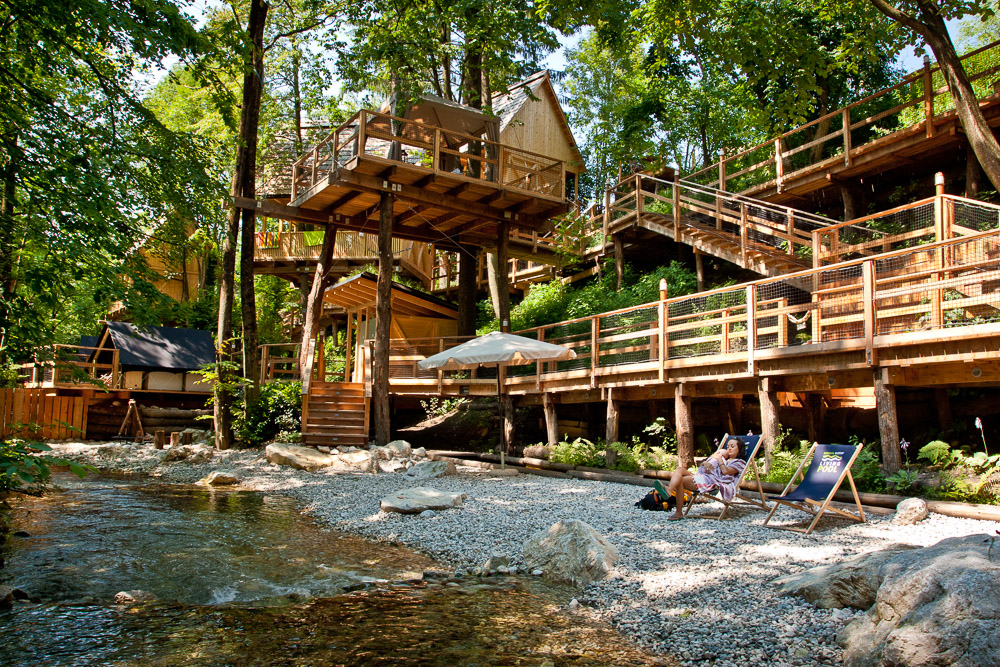
The resort consists of 23 unique accommodation units of four different types, which are, along with all associated support facilities, part of the architectural and landscape visual identity.

·        trees growing through the roofs of tree houses;

·        chemical‑free natural pool with self-cleaning plants;

·        unique wellness (different types of sauna, massage, and yoga under canopy, Kneipp pools);

·        ponds with fish under accommodation units;

·        private drinking water well;

·        unique restaurant in a greenhouse;

·        reception area with eco-shop;

·        lounge with fireplace;

·        children’s playground;

·        vegetable garden.

Now

The project has become globally renowned and has been a financial success since its very beginning. It was featured in world’s leading media National Geographic, CNN, etc.; positioned amongst to 10 Glamping resorts in the world.  In 2014 it was awarded Snovalec award (the most innovative idea in tourism) and in 2015 Sejalec (the most innovative and creative ideas in tourism). Each year, Garden Village Bled is visited by a large number of guest from all over the world. They are not just passers-by, they come with the purpose to stay at this resort.  The resort is 100% sold out.

Company info

Glamproteam d.o.o.

Zemljemerska 12

1000 Ljubljana

www.glampro.eu

glampro@glampro.eu

Glamping resort Read More »

Green certification scheme

Green Scheme of Slovenian Tourism – Slovenia Green

Introduction

The Green Scheme of Slovenian Tourism’s (GSST) key strategic objective is to introduce sustainable models to Slovenian tourism. All the objectives of GSST’s strategic guidelines are in line with sustainable development and demonstrate concern for the economic, social, cultural and natural environment. As a tool GSST carries out the following tasks under the SLOVENIA GREEN umbrella brand:

• brings together all efforts directed towards the sustainable development of tourism in Slovenia,

• offers tools to destinations and tourism businesses that enable them to evaluate and improve their sustainability endeavours,

• promotes these green endeavours through the SLOVENIA GREEN brand.

GSST is managed by the Slovenian Tourist Board. STB develops the scheme, offers educational support, and also establishes promotional channels in the international tourism market for the promotion of Slovenia Green destinations and service providers. Its accredited partner, Institute Factory of  Sustainable Tourism GoodPlace, has a licence to make assessments using the Green Destinations Standard and is a Green Destinations partner.

Process that led recognition that change was necessary

The Slovenian Tourist Board has pledged itself to sustainable development already in 2009 with the strategic guidelines and actions for sustainable development. In 2010, a Manual for hotels for implementation of sustainable business models was published and in 2011, a Partnership declaration for sustainable development was solemnly signed. In 2014, the national strategic guideline – Green Scheme of Slovenian Tourism – was adopted and in doing so, Slovenia has taken an important step towards the better sustainable development of the entire country. Businesses  and destinations are now guided into switching towards sustainable, i.e. green, development.

Description of the scheme

The GSST is based on global criteria, is globally recognised, and enables international comparison. It operates on two levels, level of destinations, including protected areas, and level of tourism businesses (hotels and tour operators/travel agencies). The levels are closely connected – the destination motivates key interested parties to operate sustainably and carry eco-labels, since a green destination can only be credible if it has a critical mass of certified service providers.

Destinations, protected areas and businesses undergo sustainability assessment after which they are awarded a Slovenia Green label. Processes and conditions vary, depending on the type of organization. Destinations follow a highly structured process of workshops, on-line tool, and questionnaires, a combination of Green Destination standard requirements and European Tourism Indicators System, after which they are awarded gold, silver and bronze certificates. Since the GSST is process oriented, all awarded destinations must regularly report to the manager and submit a sustainability action plan. Businesses on the other hand are encouraged to obtain one of the 6 eco labels the GSST endorses: Bio Hotels, EMAS, EU Ecolabel, Green Key, Green Globe or Travelife, after which they receive a Slovenia Green label. Protected areas can choose between 2 international labels (Europarc charter, Unesco Man and Biosphere Programme) or decide to follow the process for destinations.

Implementation

The scheme has first been implemented in Slovenia in 2015 with the first/pilot call for businesses and destinations. Two more calls followed, making it an annual event. There are already 23 destinations, 14 tourism service providers, 3 parks, and 2 travel agencies that have been awarded the Slovenia Green certificate. At the moment, another 16 destinations is in the process of obtaining the Slovenia Green label. Up to date list and other information about GSST is available here: https://www.slovenia.info/en/business/green-scheme-of-slovenian-tourism

Success/failure story

So far the story about GSST has been a story of success. Not only has the scheme been presented at numerous international conferences and occasions as the approach to systematically address sustainable tourism development, it has also won awards such as the National Geographic Destination Leadership award in 2017. Last year Slovenia underwent a sustainability assessment within the GSTC Destination Criteria and was declared the world’s first green destination, achieving 96% compliance with the criteria.

Company info

Slovenian Tourist Board

Dimičeva 13

1000 Ljubljana

Tel: +386 1 5898 55

info@slovenia.info

www.slovenia.info


Green certification scheme Read More »

Espace room

Enigmarium (Slovenia)

Thinking

 outside the room: designing unforgettable experiences

Introduction

Not only was Enigmarium® the first to open a real life escape room in Ljubljana in September 2014, five months later, we created the world’s first Escape Igloo® from real snow. Thus, literally the world’s coolest escape room earned us the Snovalec 2015 Award for innovation in tourism awarded by the Ministry of Economic Development and Technology – Tourism and Internationalisation Directorate in cooperation with the Slovenian Tourist Board and the agency Spirit Slovenija and even brought us to the semi-finals of the Sejalec 2016 Award. 

Having designed and created more than 20 unique escape games in Slovenia, Italy and Croatia and ranked among the most popular tourist attractions in cities such as Ljubljana, Zagreb and Maribor (TripAdvisor), Enigmarium® has become a trendsetter and leader in gamification in the Alpe Adria region.

Our proven ability to design thrilling experiences rich in a location’s cultural history has led to new innovations: from next generation escape rooms with a story fully incorporated into the local history in Maribor and Zagreb, Croatia to the gamification 

of an adventurous walk in the city centre (Unlock Ljubljana), to the gamification of a legendary outdoor exhibit at the Slovenian Alpine Museum in Mojstrana and even the gamification of a medieval castle in the Istrian village of Svetvinčenat in Croatia and the Ljubljana castle gamification project is about to be released in November 2017.

WHAT IS A REAL-LIFE ESCAPE ROOM GAME … AND WHY HAVE THEY BECOME SO POPULAR?

“Escape rooms are live-action team-based games where players discover clues, solve puzzles, and accomplish tasks in one or more rooms in order to accomplish a specific goal (usually escaping from the room) in a limited amount of time.

Escape rooms require teamwork, communication, and delegation as well as critical thinking, attention to detail, and lateral thinking. They are accessible to a wide range of players; in fact, the most successful teams are those that are made up of players with a variety of experiences, skills, background knowledge, and physical abilities.” 

Nicholson, Scott. (2015). “Peeking behind the locked door: A survey of escape room facilities.

Legend: Google trends: keyword search “escape room” over time

Source: Google trends

ESCAPE ROOMS TODAY

“Escape rooms are a global tourist phenomenon, with each larger tourist city today offering several if not dozens of them. Listing web pages such as Escapereviewer.com and Escaperoomdirectory.com, for instance, include more than 70 countries, with over 3,700 companies and over 8,000 rooms currently operating worldwide”. Prof. dr. Tomaž Kolar, Faculty of Economics at the University of Ljubljana;

Kolar, Tomaz (2017) “Conceptualising tourist experiences with new attractions: the case of escape rooms”, International Journal of Contemporary Hospitality Management

Description of the original product

Today (Oct 2017) Enigmarium® runs 6 escape room games in Ljubljana, 5 games in Maribor, 3 in Zagreb, 2 in Laško and one in Murska Sobota.  We are ranked among the most popular tourist activities in towns (Trip Advisor). It pays off that Enigmarium games are original, each one based on different story with unique challenges that you won’t see anywhere else, along with playful high-tech “gadgets”, developed by our Escape Lab team. We have conceived the challenges in such a way that each player has something to contribute. Not only is there no need to know a foreign language, but the game flow and the dramaturgical arc will keep the players on their toes until the very last second. We take great care that at Enigmarium® you’ll find the friendliest gamemasters who are happy to spring to players aid (if needed) and to ensure that playing our escape game becomes an unforgettable adventure! That‘s why Escape Room Center in Ljubljana and Maribor received the “Certificate of Excellence 2016 and 2017“ from TripAdvisor.

Process that led recognition that change was necessary

VISITORS TODAY

Today’s visitors to an attraction or to a city don’t want to be passive observers, they want to take part and enjoy in an active experience, an authentic experience and want the best value for the money / to pay for quality experiences.

“The evolving tourist is a hedonistic experience -seeker who is a discerning individualistic participant, seeking authentic experiences and value for money.” Prof. dr. Tomaž Kolar, Faculty of Economics at the University of Ljubljana

Kolar, Tomaz (2017) “Conceptualising tourist experiences with new attractions: the case of escape rooms“, International Journal of Contemporary Hospitality Management

FIERCE COMPETITION

Every day a new escape room opens and market is becoming oversaturated. If we wanted to stay on the top in the region, we have to constantly develop and innovate. We must research and evolve the escape room experience.

ESCAPE ROOMS WITH ADDED VALUE

That’s why in our rooms in Maribor (Hannibal, September 2015)  and  Zagreb (the mysterious case of Zagreb’s Witch, April 2016) , you travel by time machine to discover a story, ambient, challenges and amazing high-tech gadgets completely immersed in the city’s history.

We wanted to create something new for tourists who wanted to experience a real story connected with the place they are visiting. We researched Zagrebʼs history to find something extraordinary, and extracted the story from an actual historical court file about Barica Cindek, a woman accused of witchcraft in 1743. Players uncover the story of beautiful Barica, who was accused of witchcraft and sentenced to burn at the stake. They have to find the passage to the 18th century and save her.

We went through the same process in Maribor: in the city’s archive files we found a story about Dr. Hannibal Bottinoni, a provincial-ducal doctor of infectious diseases from Venice, who  was the only doctor who dared to treat people with the plague, because he had a secret recipe that kept him healthy. Players have to travel back in time to discover his secret and learn about that era in a fun way.

DECREASING NUMBER OF VISITORS TO MUSEUMS

There is an interesting fact about the visitors to museums: even though there are more foreign visitors to cities in Slovenia, the number of the foreign visitors to museums is decreasing.

Source: SURS Statistični urad Republike Slovenije (Republic of Slovenija Statistical Office) 

With that in mind, we have developed different escape games or gamification projects, which are the perfect solution for people seeking activities in which they play the main role.

Process that facilitated change

GAMIFICATION – DESIGNING UNFORGETTABLE EXPERIENCES

Gamification expands the realm in which you can apply the principles of escape room games. It is the process of taking something that already exists and integrating elements of game play into it to create a new experience that motivates participation, engagement and loyalty.

Our proven ability to design thrilling experiences rich in a location’s cultural history, such as our escape rooms in Maribor and Zagreb which are fully immersed in the history of each city, has led to new innovations and different spaces we will present below: 1) the gamification of the city centre, 2) the gamification of an exhibit at a museum and 3) the gamification of a medieval castle.

Implementation

1)      THE GAMIFICATION OF AN ADVENTURE WALK IN THE CITY CENTRE: UNLOCK®

An adventure walk in the city centre, branded as “Unlock®” becomes an interactive and challenging way to actively explore a city by combining familiar aspects of an escape room game such as puzzles, surprise twists and a locked (trademarked!) book to reveal a cityʼs unique history and forgotten secrets. Today you can play Unlock® in Ljubljana, Maribor and Zagreb, and in the popular spa and brewery town of Laško, Slovenia.

You will literally escape from a room in this completely new game with the favourite elements of an “escape room” adventure – but this time in the fresh air! On an adventurous journey through the old city centre, players will encounter 7 entertaining tests, through which they will unlock the secrets of the city history, discover the unknown, be pleasantly surprised, exclaim “Eureka!” and have a blast. 

The game is suitable for teams of two to five players and even larger groups – up to 20 groups at the same time or up to 100 players. The Participants of the Global Green Destinations Day Conference, held on World Tourism Day 2016 in Ljubljana, also had a great time.

2)      MUSEUM GAMIFICATION: A GAMIFIED TRAIL TO AN EXHIBIT AT THE SLOVENIAN ALPINE MUSEUM IN MOJSTRANA

The Slovenian Alpine Museum invited the Enigmarium® team to conceive and realise a pioneer innovation in the field of museum gamification by making “Escape to the Bivouac”, a playful adventure path added to its existing exhibit. 

It is not a classic “escape room, where the game is led by a gamemaster, but an innovative way of exploring a museum through (game)play that we have developed specifically for the project. A mountain storm is coming and you must Escape to the Bivouac. A storm is coming and the players must make it through the four challenges associated with mountaineering skills to survive.

In May 2017, the Slovenian Alpine Museum received the prestigious “Valvasor Recognition for 2016” bestowed by the Association for Slovene Museums for the project: “Escape to the Bivouac”. In September 2017, the Forum of Slavic Cultures (FSC) bestowed the museum the award for the best Slavic museum, the 4th Živa Award.

3)      MEDIEVAL CASTLE GAMIFICATION – “ESCAPE CASTLE” IN SVETVINČENAT NEAR PULA, CROATIA

In a fun-filled adventure in the beautiful medieval castle Morosini Grimani in the idyllic setting of Istria’s Svetvinčenat (Croatia), players will embark on a unique and original adventure. To top it off, the story takes place in a genuine castle and includes puzzles brimming with actual legends and historical facts all which guarantee a realistic immersive experience!

We are proud that the Municipality of Svetvinčenat entrusted our team with this innovative pioneer project of the first gamification of a castle, a project that has not only brought the castle, its walls and the local legends to life, but has enhanced the entire municipality’s offering.

This completely original (and copyright protected) project marks an innovation in the field of “escape games” – a unique upgrade and intervention that did not interfere in any way with the cultural heritage – and it allows for up to 6 teams to play simultaneously in the castle.

Escaping from a (real) castle has never been as fun as this!

Thatʼs why our next project of the gamification is taking place at Ljubljana Castle – the most visited tourist attraction in Slovenia.

Future

OUR VISION FOR THE FUTURE

Whatʼs next? While some people have been asking if the escape room trend will die out soon, we at team Enigmarium® have been asking ourselves: Where else can this gaming approach enhance our lives, our cities and cultural heritage?

We see escape rooms not only as entertainment or even edutainment but also as a powerful mechanism for groups of people to bond and enrich their communication and relations in a positive and challenging way – how can we combine funology and gamification with motivation training and teambuilding? How we can enrich our cultural heritage?

Our competitive advantage is that we are constantly innovating fresh concepts and ideas.

Besides unique solutions for the Gamification of tourist attractions, you’ll find a new escape room in Laško (August 2016). The theme is completely immersed in the city’s rich history. In the same house, where the first mug of beer was brewed, you can discover a story, atmosphere, challenges and amazing high-tech gadgets all coordinated with the brewery theme. You can use all your senses there and even learn something.

Wrap-up

The recipe for success is in: an authentic story + immersive ambient + fun and logical challenges + great game flow = AN UNFORGETTABLE EXPERIENCE

Company info

Nataša POTOČNIK

Creative Director and Co-founder, Escape Room Enigmarium®

natasa.potocnik@enigmarium.si

ESCAPE ROOM ENIGMARIUM® 

Dunajska 76 | SI-1000 LJUBLJANA, Slovenia

+386 (0) 31 33 44 88  | www.escape-room.si

References

Nicholson, Scott. (2015). “Peeking behind the locked door: A survey of escape room facilities.” White Paper. Available at http://scottnicholson.com/pubs/erfacwhite.pdf

Tomaz Kolar, (2017) “Conceptualising tourist experiences with new attractions: the case of

escape rooms”, International Journal of Contemporary Hospitality Management, Vol. 29 Issue: 5,

pp.1322-1339, doi: 10.1108/IJCHM-12-2015-0687 

__

SURS Statistični urad Republike Slovenije (SORS Republic of Slovenia Statistical Office) http://pxweb.stat.si/pxweb/Dialog/varval.asp?ma=1059913E&ti=&path=../Database/Demographics/10_culture/03_10599_museum_galleries/&lang=1

Home page Escape room Enigmarium: https://escape-room.s


Espace room Read More »

Green certification scheme

Green Scheme of Slovenian Tourism – Slovenia Green

Introduction

The Green Scheme of Slovenian Tourism’s (GSST) key strategic objective is to introduce sustainable models to Slovenian tourism. All the objectives of GSST’s strategic guidelines are in line with sustainable development and demonstrate concern for the economic, social, cultural and natural environment. As a tool GSST carries out the following tasks under the SLOVENIA GREEN umbrella brand:

• brings together all efforts directed towards the sustainable development of tourism in Slovenia,

• offers tools to destinations and tourism businesses that enable them to evaluate and improve their sustainability endeavours,

• promotes these green endeavours through the SLOVENIA GREEN brand.

GSST is managed by the Slovenian Tourist Board. STB develops the scheme, offers educational support, and also establishes promotional channels in the international tourism market for the promotion of Slovenia Green destinations and service providers. Its accredited partner, Institute Factory of  Sustainable Tourism GoodPlace, has a licence to make assessments using the Green Destinations Standard and is a Green Destinations partner.

Process that led recognition that change was necessary

The Slovenian Tourist Board has pledged itself to sustainable development already in 2009 with the strategic guidelines and actions for sustainable development. In 2010, a Manual for hotels for implementation of sustainable business models was published and in 2011, a Partnership declaration for sustainable development was solemnly signed. In 2014, the national strategic guideline – Green Scheme of Slovenian Tourism – was adopted and in doing so, Slovenia has taken an important step towards the better sustainable development of the entire country. Businesses  and destinations are now guided into switching towards sustainable, i.e. green, development.

Description of the scheme

The GSST is based on global criteria, is globally recognised, and enables international comparison. It operates on two levels, level of destinations, including protected areas, and level of tourism businesses (hotels and tour operators/travel agencies). The levels are closely connected – the destination motivates key interested parties to operate sustainably and carry eco-labels, since a green destination can only be credible if it has a critical mass of certified service providers.

Destinations, protected areas and businesses undergo sustainability assessment after which they are awarded a Slovenia Green label. Processes and conditions vary, depending on the type of organization. Destinations follow a highly structured process of workshops, on-line tool, and questionnaires, a combination of Green Destination standard requirements and European Tourism Indicators System, after which they are awarded gold, silver and bronze certificates. Since the GSST is process oriented, all awarded destinations must regularly report to the manager and submit a sustainability action plan. Businesses on the other hand are encouraged to obtain one of the 6 eco labels the GSST endorses: Bio Hotels, EMAS, EU Ecolabel, Green Key, Green Globe or Travelife, after which they receive a Slovenia Green label. Protected areas can choose between 2 international labels (Europarc charter, Unesco Man and Biosphere Programme) or decide to follow the process for destinations.

Implementation

The scheme has first been implemented in Slovenia in 2015 with the first/pilot call for businesses and destinations. Two more calls followed, making it an annual event. There are already 23 destinations, 14 tourism service providers, 3 parks, and 2 travel agencies that have been awarded the Slovenia Green certificate. At the moment, another 16 destinations is in the process of obtaining the Slovenia Green label. Up to date list and other information about GSST is available here: https://www.slovenia.info/en/business/green-scheme-of-slovenian-tourism

Success/failure story

So far the story about GSST has been a story of success. Not only has the scheme been presented at numerous international conferences and occasions as the approach to systematically address sustainable tourism development, it has also won awards such as the National Geographic Destination Leadership award in 2017. Last year Slovenia underwent a sustainability assessment within the GSTC Destination Criteria and was declared the world’s first green destination, achieving 96% compliance with the criteria.

Company info

Slovenian Tourist Board

Dimičeva 13

1000 Ljubljana

Tel: +386 1 5898 55

info@slovenia.info

www.slovenia.info


Green certification scheme Read More »

Shower device nudging hotel guests to save water

Aguardio Sensor and Display (Denmark)

Description of the innovation

A small Aguardio Sensor and Display have been installed in the shower cabins of a hotel. The display shows the hotel guest how much time she spends in the shower. The purpose is to nudge the guest to save water while showering and thus protect the environment. And, as it turns out, the hotel guests like this sort of sustainable initiatives.

Process that led recognition that change was necessary

The last statement in the previous paragraph is one of the findings of a qualitative user study carried out by the Alexandra Institute at two Danish hotels: Hotel Sixtus and Danhostel. At both hotels, the rooms have been fitted with sensors and displays developed by the Danish start-up Aguardio ApS.

One of the key focus areas of our study was to find out if people take longer showers at the hotel than at home. The assumption was that they take longer and more luxurious showers at the hotel because they have more time there than at home. However, our study showed that this is not necessarily the case. The guests support the initiative when they are presented with the hotel’s narrative on saving water and becoming more sustainable.

Process that facilitated change

To Jens Worsøe and his wife, who manage Danhostel in Kalundborg, it has been a natural step forward to have the solution installed in their 29 rooms. From day one, they have strived to be as environmentally friendly as possible, so an initiative of this nature is in line with the hostel’s DNA. The hostel already boasts The Organic Cuisine Label and the Green Key.

“We have had an idea about how much water our guests use during their stay, but basically we didn’t know where the consumption came from. Was it because people forgot to turn off the tap while they were brushing their teeth, or because they were showering? Now we have a tool that enables us to collect data about our guests’ shower behavior, which is also in line with our sustainable goals,” he explains.

Implementation

The sustainable narrative is extremely important, says Marie Rørdam Fenger, Senior Digital Innovation Specialist at the Alexandra Institute. She is part of the team that conducted the qualitative study which consisted of observations and interviews with guests and staff at the two hotels.

One of the key findings is that technology does not work alone. You cannot simply put up a sensor and expect people to understand that it helps them save water. Sometimes the guests were unsure if the box in the shower cabin was a humidity sensor, a scent diffuser, a surveillance camera, or something totally different.

But as soon as the guests were told that technology contributes to the hotel’s sustainable goals, they completely understood. Therefore, hotels should not be afraid to communicate that narrative to their guests.

“Our study reveals that the hotels are worried that their guests will find the solution intrusive or that it has been installed for reasons of economy. In reality, this is not the case if they are told that the solution is meant to support the hotels’ core values. If the hotels ‘walks the talk’, they should not be afraid to communicate that they are sustainable because the guests are generally very positive”, explains Marie Rørdam Fenger.

It is also important to engage the staff and use them as ambassadors to get the sustainable message across to the guests: that the technology is there to help the hotel meet its sustainability goals.

”That is not the only reason though. The employees are actually proud when their employer makes sustainable choices. It is satisfying to work for a company that makes an active choice to reduce its impact on the environment, and that attitude also plants a seed with the guests,” she explains.

Success story

According to Thomas Munch-Laursen, CEO and co-founder of Aguardio, the study backs up the assumption that hotel guests embrace sustainable initiatives.

”We have received very positive feedback, which has given us an idea about how guests perceive our solution. Do they accept and act on it? Or are they indifferent? Luckily, it turned out to be the first. This also supports our thesis that our product is relevant for hotels that already engage in sustainable practices. An essential takeaway is that technology cannot stand alone,” explains Thomas Munch-Laursen.

Aguardio is constantly strengthening the narrative around their solution. An important part of the narrative is that the solution is an extension of the ‘towel principle’ where hotels encourage guests to reuse their towels.

“Some people object to the concept because they don’t want to be ‘under surveillance’. This is not our agenda at all. The data we collect is anonymous and will be used to improve the guest experience and hotel operations. Whether you are in the shower for 18 minutes or 8 minutes is not interesting. We want to know if the guest changes behavior when he or she is made aware of the purpose,” he explains.

According to Thomas Munch-Laursen, the study has helped us verify how the users perceive Aguardio’s product. “As an engineer, you often believe technology is amazing. But do your customers understand the product? We soon realized that if we were to succeed with our solution, it is important to understand how the users interact with it. Identifying and incorporating soft values is essential for product development and should never be underestimated. I think many other products would benefit from that approach too,” he says.

Company and contact info

Aguardio ApS
Lysholt alle 8, Vejle, 7100 Denmark
Thomas Munch-Laursen, +4522919886,
tml@aguardio.com
http://www.aguardio.com

Shower device nudging hotel guests to save water Read More »

Socially run hotel

magdas HOTEL (Austria)

Introduction

Run by twenty former refugees and ten hotel professionals, in cooperation with artists, architects and students, magdas HOTEL is something different: a place for meetings and connections, going beyond regular hotel experience. A stylish lounge, cafe, library, and garden bring together tourists, neighbors, park visitors, the local creative scene, students from the art academy next door. Readings, exhibitions, concerts, film nights, discussions and social dinners mean the hotel is always alive with the exchange of ideas.

Description of the product

Business-focused, socially run magdas HOTEL is part of Caritas Vienna’s Social Business group. Their aim is to address social matters through a market approach, wherever possible. The concept of a social business is based on Nobel Prize-winner Muhammed Yunus: all income is reinvested, to create more social change. The hotel does not receive any public funding that is not also available to other companies. magdas HOTEL must be self-financing, without losing sight of its ultimate goal: improving the lives of otherwise marginalised people.


Process that facilitated change

Migrants with a refugee background face problems in finding work in Austria. Challenges include a lack of German, a reluctance on the part of some employers, and a long wait (of months or sometimes years) before the approval of asylum status, which is a requirement for legal employment. Founders were convinced that staff who come from around the world bring real advantages to a hotel business – skills, talents, languages and cultural insights – that give magdas HOTEL a significant advantage over its competitors. The experience since the opening of the hotel confirms this.


Implementation

From modest resources – come great things… The project is based in a former Caritas retirement home and financed via crowdfunding of € 57,306, plus a € 1.5m loan from Caritas Vienna. To enable the adaptation of the building, on a limited budget, upcycling was a key element from the start. With help from renowned architects AllesWirdGut and artist Daniel Buechel, the nine-month turnaround involved taking fitted cupboards from the original nursing home and turning them into benches, tables, and lamps. Old doors became new mirrors – and even luggage racks from Austrian trains now hold suitcases in each room. Enthusiastic volunteers got involved at every stage, from knitting lampshades to growing herbs in the garden. Students and staff from the neighboring Academy of Visual Arts have produced art to decorate each room, meaning every guest has a unique view. The design of each room was completed by furniture donated by the public, and also Caritas’s own used furniture shop, CARLA. This all goes to show that commitment, flexibility and creative ideas can more than make up for limited financial means. In 2015 magdas HOTEL was rewarded with the Austrian State Prize for Design.


Facts & Figures

– Opened in February 2015
– 20 former refugees and 10 experienced hotel staff
– 16 nationalities
– More than 20 languages spoken
– 88 rooms in five categories, 60% with balconies and three with wheelchair access
– Suites and penthouse have TV and satellite
– Salon with lounge and bar, terrace and library 
– …

Company and contact info

+43 676 45 45 322
 
Caritas Services GmbH
Office: 1070 Wien, Wimbergergasse 14-16
Company address: 1160 Wien, Albrechtskreithgasse 19-21

Socially run hotel Read More »

Beer fountain Žalec

Beer Fountain Green Gold: An innovative tourist product for sustainable development of tourism in Municipality Žalec (Slovenia)

  Author: Hana Šuster Erjavec, PhD, Deputy Mayor of Municipality Žalec

Introduction

Beer Fountain Green Gold is an innovative tourism product, first of a kind in the world. The originality of the idea lies in the fact that it connects our hops heritage, which is deeply rooted in the Savinja Valley, with the present time and preserves it for the future. Its uniqueness lies in the fact that the Beer Fountain Green Gold is an innovative concept of beer tasting, hops narrative stories, an attractive architectural object and perfection of technology.

Process that led recognition that change was necessary

Municipality Žalec is the 17st biggest municipality in Slovenia with the city of Žalec as an administrative, economic and political center of Lower Savinja Valley. In the Development Strategy of Žalec Municipality 2014 – 2020 tourism is recognized as an important prosperous industry. We have lots of tourist attractions but till now we were not satisfied with number of tourists visiting Žalec and the visibility of Lower Savinja Valley among tourists. In searching for a solution that would place us on the map of global tourist destinations, it was clear to everyone that we needed something exceptional, unique and connected to our hop and beer heritage. Namely Slovenia is at the 5th place in world’s hop production and the vast majority of hops comes from Lower Savinja Valley. Hops has deeply marked our valley and its habitants: economically, anthropologically and sociologically. In Žalec sites the Slovenian Institute of Hop research and Brewing, one of three in the world. Besides the Institute stands The Eco-Museum of Hop-Growing and Brewing Industry in Slovenia, which transfers our rich heritage of hop plants to future generations. The resident of Žalec was famous Simon Kukec, the father of brewing, after which the municipality named its own brand name of beer. Thus, the idea of a beer fountain, a first-class tourist attraction, which would connect our heritage with the present time and preserve it for the future and attract tourists to Žalec, was created.

From idea to implementation

The idea of a beer fountain was so outlandish that some residents of Žalec, representatives of the local community and even some media representatives did not believe in its realization. Development of a new product is associated with risk, especially if it is a product with such a high level of novelty as this. The risk cannot be circumvented, but it can be reduced and we did this by carefully developing the new product according to the marketing theory and practice. We formed a team of experts from various fields. The project team went through numerous difficulties through the time as the idea was being implemented. The biggest promotor of the product realization was the mayor Janko Kos itself. He believed in the realization of beer fountain from the beginning and supported team’s decisions all the time throughout the implementation phase. The construction of the beer fountain with a technical solution was estimated at 350,000 euros. But we didn’t want to finance the entire amount by the municipal budget, because the project was not approved by all public. We turned to entrepreneurs and businessmen of our municipality to help us raising funds. They believed in the idea of a beer fountain and saw it as an opportunity for tourism development and economic growth, so they have donated some funds. Some residents of the municipality, who considered the idea worthwhile to be realized, have also donated certain amounts. At the end, more than half of the funds needed for the project realization was collected through donations. Good motivation for realization of the beer fountain was also the recognition of Slovenian Tourist Board for the idea of beer fountain as an innovative new product in tourism. They awarded us with the prize of Creator (Snovalec) 2016 for “a successful combination of authentic local stories from the past and present, for an innovative way to carry out promotion of Žalec, Savinja Valley of Hops and Slovenia and also for successfully combining the interests of diverse public and private partners in a common project.” High visibility in domestic and foreign media (BBC, Daily Mail, Lonely Planet, Food & Wine, New York Post …) already during the implementation phase has also helped us a lot, especially in building awareness of the fountain by the target audience. The construction work started in April 2016 and in accordance with the timetable the Grand opening of the Beer Fountain Green Gold was on 6th September 2016 on the Municipality day.

Description of the product

A fountain is symbolically designed as a Hop umbel, expressed in two semicircles or fountains: beer fountain and water fountain. We have a slogan: “in the embrace of green gold”. Both Fountains symbolically embrace themselves. A visitor buys a special beer mug under which there is a chip with an information that beer can be filled 6 times with an amount of 1 deciliter. The special beer mug is designed by world-renowned designer Oskar Kogoj (he is also our honorary citizen) and can be taken home. All selected beers at the beer fountain are brewed with Slovenian hops.

Successful story and further development

The Beer Fountain Green Gold was succinctly described by the largest publisher of travel guides Lonely Planet as: “The small town of Žalec in eastern Slovenia is planning to put itself on the map by building Europe’s first beer fountain”. Marketing activities with good public relations helped us that during the first season which lasted only 2 months (the Fountain is closed in winter) we have sold 36.136 mugs, and more than 94.000 until October 2017. We have planned to sell about 6.000 mugs in one year, so we have enormously exceeded our expectations. As the mayor of Žalec Janko Kos said: “The number of mugs surpassed our most optimistic forecasts. However, we did not overestimate that the Fountain will become a magnet for other tourist providers, souvenir makers, caterers and tourist workers, will raise local economy and become a flagship of tourism in the Lower Savinja Valley”. The Beer Fountain Green Gold has become the basis of a broad, wide and innovative tourist offer of the Žalec Municipality and a basis for the economic growth and prosperity of its citizens. It has become an inspiration for everybody who is looking for a business opportunity in realizing innovative ideas, confirmed by Slovenian Tourist Board award Sower (Sejalec) 2017, following the previous Creator (Snovalec) 2016 award. With implementing the beer fountain, we have proved that even the most unusual idea can be realized, only if you are brave, pervasive and you trust in your knowledge and intuition.

Organization info

Žalec Municipality www.zalec.si glavna.pisarna@zalec.si Ulica Savinjske čete 5, 3310 Žalec, Slovenia t: 03 713 63 20

Beer fountain Žalec Read More »

We use cookies to give you the best online experience. By agreeing you accept the use of cookies in accordance with our cookie policy.

Privacy Settings saved!
Privacy Settings

When you visit any web site, it may store or retrieve information on your browser, mostly in the form of cookies. Control your personal Cookie Services here.

These cookies are necessary for the website to function and cannot be switched off in our systems.

In order to use this website we use the following technically required cookies
  • wordpress_test_cookie
  • wordpress_logged_in_
  • wordpress_sec

Decline all services
Accept all Services