AIRTH Encyclopedia contributing members – practitioners

The process of innovation

Isabel Rodriguez, University of Surrey

HOW TO CITE:

Rodriguez, I. (2018). The process of innovation. In AIRTH Encyclopedia of Innovation in Tourism and Hospitality. Retrieved: , from http://www.airth.global 

Introduction

Innovation is often thought as an outcome; however, the innovation process, or how innovations are developed and implemented over time[i], has tended to be and still largely is a ‘black box’, whose complex internal workings are poorly understood[ii].  This knowledge gap is especially acute in tourism.

Theories and models, especially from the 80s based on manufacturing and studying successful intrapreneurs within major corporations have traditionally given an oversimplified image of the innovation process as linear and formed by a predictable sequence of stages[iii] [iv]. According to Schroeder et al. (1986)1, stage models were too simplistic to explain complex innovation processes and subsequent literature would characterize the innovation process as inherently dynamic[v], uncertain[vi], random and slightly chaotic[vii] [viii] with unpredictable delays and setbacks.

During the innovation journey, entrepreneurs engage in a sequence of events that transform a new idea into an implemented reality4. According to Kanter[ix], these broadly correspond to the unfolding innovation process: idea generation, coalition building, idea realization and transfer or diffusion. The time-order of the tasks described below, however, is non-linear.

Idea generation

Innovation begins with entrepreneurs who sense a new opportunity which is then repeatedly evaluated engaging with informed individuals, doing a preliminary market testing or financial viability analysis, etc.   

Coalition building

This task involves power acquisition by bringing potential allies into the process. The sources of power can consist of knowledge, finance, time and space resources, or support in the form of backing or approval.

Idea realization

This task involves turning the idea into something tangible, such as a prototype. There are also critical organizational challenges. In start-ups, this task not only gives rise to the innovation but also the entire business.

Transfer or diffusion

The innovation process culminates with the commercialization or the adoption of the innovation by users. Customer adoption will determine the success or failure of the innovations.

Relevance for tourism innovation research

Rodriguez et al. (2017) have studied the innovation process of a sample of tourism entrepreneurs and the finding both confirm and challenge existing ideas about the innovation process in the field of tourism. The innovation process in tourism is especially dynamic and agile with customer interaction being integral[x].  The study empirically provides confirmation that the process does not follow the linear stages of existing traditional models which describe innovation in already established manufacturing firms (e.g. Stage Model of Cooper or Kanter’s model). The start-up process analyzed has more agile dynamics in which a product or service – even if not necessarily fully developed – is quickly and constantly evaluated and adapted to the market (see Figure 1 below). Knowledge is not incorporated through deep formal initial research but progressively through experimentation. This Doing, Using and Interacting experienced-based mode of learning[xi] has also been noted by Nordin and Hjalager[xii] in their Icehotel innovation case study and seems to be appropriate to the tourism sector. User-driven and agile innovation approaches or methods which have gained progressive importance (e.g. Lean Startup) are inspiring new practices which require rethinking existing frameworks especially when dealing with more innovative projects[xiii]. To accelerate the process, many activities overlap rather than forming a neat, orderly sequence. This is especially evident in the constant evaluation and coalition building over time with different key stakeholders. Evaluation is critical to guiding this process, with learning and flexible modification of the existing path. This work also challenges some assumptions. For example, Kanter (1983, 1988) considered that coalition building was the second task of the process however in the tourism sample analyzed this was a transversal and continuous task throughout the journey.

The heterogeneity and the contingent nature of the innovation process mean that caution is required with respect to generalization and extrapolation of this study’s findings: the results are context-dependent, and the sample selection involves specific types of entrepreneurs and innovations, and is tied to the development of a start-up. The innovation process is also affected by the context (cultural, political and institutional) and might differ in other tourism innovation journeys (e.g. less technological forms of innovation, more complex, R&D intensive and higher risk projects), and this need to be analyzed.

Figure 1. A model of the innovation process based on the study of a sample of innovative tourism entrepreneurs


[i] Schroeder, R., Van de Ven, A., Scudder, G., & Polley, D. (1986). Managing innovation and change processes: findings from the Minnesota Innovation Research Programme. Agribusiness, 2(4), 501-523.

[ii] Garud, R., Tuertscher, P., & Van de Ven, A. H. (2013). Perspectives on innovation processes. The Academy of Management Annals, 7(1), 775-819. http://doi.org/10.1080/19416520.2013.791066

[iii] Cooper, R. (1994). Third generation new product processes. Journal of Product Innovation Management11(1), 3-14. http://doi.org/10.1016/0737-6782(94)90115-5

[iv] Van de Ven, A., Polley, D., Garud, R., & Venkataraman, S. (1999). The innovation journey. New York: Oxford University Press.

[v] Kline, S. J., & Rosenberg, H. (1986). An overview of innovation. In R. Landau & R. Rosenberg (Eds.), The positive Sum Game (pp. 275-305). Washington DC: National Academy Press.

[vi] Kanter, R. M. (1983). The Change Masters. London: Unwin.

[vii] Quinn, J. (1985). Managing innovation: Controlled chaos. Harvard Business Review63(3), 73-84. http://doi.org/10.2139/ssrn.1504499

[viii] Tushman, M., & Anderson, A. (1986). Technological discontinuities and organizational environment. Administrative Science Quarterly31(3), 436-465. http://doi.org/10.2307/2392832

[ix] Kanter, R. M. (1988). When a thousand flowers bloom: structural, collective, and social conditions for innovation in organisations. In L. L. Cumming (Ed.), Research in organizational behavior (pp. 169–211). Greenwich, CT: JAI Press

[x] Hjalager, A. M. (2010). A review of innovation research on tourism. Tourism Management31, 1-12. http://doi.org/10.1016/j.tourman.2009.08.012

[xi] Jensen, M. B., Johnson, B., Lorenz, E., & Lundvall, B. Å. (2007). Forms of knowledge and modes of innovation. Research policy, 36(5), 680-693. http://doi.org/10.1016/j.respol.2007.01.006

[xii] Nordin, S., & Hjalager, A. (2017). Doing, Using, Interacting: Towards a New Understanding of Tourism Innovation Processes. In A. Kiráľová (Ed.), Driving Tourism through Creative Destinations and Activities (pp. 165-180). Hershey, PA: IGI Global.

[xiii] Cooper, R. G. (2016). Agile–Stage-Gate Hybrids. Research-Technology Management, 59(1), 21-29. http://dx.doi.org/10.1080/08956308.2016.1117317

The process of innovation Read More »

Schumpeter’s Theory of Economic Development

One of the fathers of modern innovation theories is the political economist Joseph A. Schumpeter (1883-1950). Here are a few basic notes about his contributions from the two sources:
 
EconomicsDiscussion.net
 
 
The following points highlight the four important features of Schumpeter’s theory of economic development.
 
“Feature # 1. Circular Flow:
Schumpeter starts his analysis of development process with the concept of circular flow. It implies a condition where economic activity produces itself continuously at constant rate through time.”
 
“Feature # 2. Role of the Entrepreneur:
Entrepreneur or innovator is the key figure in Schumpeter analysis of the process of development. He occupies the central place in the development process because he initiates development in a society and carries it forward. Entrepreneurship is different from managerial activity.”
 
“Feature # 3. Business Cycle or Cyclical Process:
The next component of development according to Schumpeter is the business cycle. Schumpeter’s approach to business cycle or crisis is historical, statistical and analytical. He believes that business cycle or crisis is not merely the result of economic factors but also of non-economic factors. Schumpeter concludes that crisis is the “process by which economic life adapts itself to the new economic conditions”.”
 
“Feature # 4. The Decay of Capitalism:
The continuous technical progress results in an unbounded increase in total and per capita output. As long as technological progress takes place, the rate of profit is positive. Hence, there can be no drying up of sources of investible funds nor any vanishing of investment opportunities.”
__
 
Where to go from here? In one of the interpretations Karol Sledzik elaborates “Schumpeter’s view on Innovation and Enterpreneruship” like this:
 
Academia.edu
 
 
“We are living in a complex and dynamic world in which innovation and entrepreneurship are occupying a decisive role for economic development. According to Joseph Alois Schumpeter “carrying out innovations is the only function which is fundamental in history”. He also accented that it is entrepreneurship that ”replaces today’s Pareto optimum with tomorrow’s different new thing”. Schumpeter’s words that entrepreneurship is innovation have never seemed so appropriate as the nowadays, when modern capitalism is experiencing a serious crisis and lost his strength during last subprime and euro-debt crises. The purpose of this paper is the analysis of the Schumpeter’s innovation concept in a context of “first” and “second” Entrepreneurship theory.”

Schumpeter’s Theory of Economic Development Read More »

Disruptive innovation

One of the more recent theories brings “disruptive warning” to organizations. Watch your back; and front! Two established sources describe these warnings as follows.

Harward Business Review

https://hbr.org/2015/12/what-is-disruptive-innovation

““Disruption” describes a process whereby a smaller company with fewer resources is able to successfully challenge established incumbent businesses. Specifically, as incumbents focus on improving their products and services for their most demanding (and usually most profitable) customers, they exceed the needs of some segments and ignore the needs of others. Entrants that prove disruptive begin by successfully targeting those overlooked segments, gaining a foothold by delivering more-suitable functionality—frequently at a lower price. Incumbents, chasing higher profitability in more-demanding segments, tend not to respond vigorously. Entrants then move upmarket, delivering the performance that incumbents’ mainstream customers require, while preserving the advantages that drove their early success. When mainstream customers start adopting the entrants’ offerings in volume, disruption has occurred.”

Clayton Christensen

http://www.claytonchristensen.com/key-concepts/

“Characteristics of disruptive businesses, at least in their initial stages, can include:  lower gross margins, smaller target markets, and simpler products and services that may not appear as attractive as existing solutions when compared against traditional performance metrics.  Because these lower tiers of the market offer lower gross margins, they are unattractive to other firms moving upward in the market, creating space at the bottom of the market for new disruptive competitors to emerge.”

Disruptive innovation Read More »

Diffusion of innovation theory

This is a well established general theory often used in tourism innovation research. Here are excerpts from two online sources that cover the topic in more detail:

Boston University

http://sphweb.bumc.bu.edu/otlt/MPH-Modules/SB/BehavioralChangeTheories/BehavioralChangeTheories4.html#headingtaglink_1

 
“Diffusion of Innovation (DOI) Theory, developed by E.M. Rogers in 1962, is one of the oldest social science theories. It originated in communication to explain how, over time, an idea or product gains momentum and diffuses (or spreads) through a specific population or social system. The end result of this diffusion is that people, as part of a social system, adopt a new idea, behavior, or product.   Adoption means that a person does something differently than what they had previously (i.e., purchase or use a new product, acquire and perform a new behavior, etc.). The key to adoption is that the person must perceive the idea, behavior, or product as new or innovative. It is through this that diffusion is possible.  
 
Adoption of a new idea, behavior, or product (i.e., “innovation”) does not happen simultaneously in a social system; rather it is a process whereby some people are more apt to adopt the innovation than others.   Researchers have found that people who adopt an innovation early have different characteristics than people who adopt an innovation later. When promoting an innovation to a target population, it is important to understand the characteristics of the target population that will help or hinder adoption of the innovation. There are five established adopter categories, and while the majority of the general population tends to fall in the middle categories, it is still necessary to understand the characteristics of the target population. When promoting an innovation, there are different strategies used to appeal to the different adopter categories.”
 
“The stages by which a person adopts an innovation, and whereby diffusion is accomplished, include awareness of the need for an innovation, decision to adopt (or reject) the innovation, initial use of the innovation to test it, and continued use of the innovation. There are five main factors that influence adoption of an innovation, and each of these factors is at play to a different extent in the five adopter categories.”
 
 
“Diffusion research examines how ideas are spread among groups of people.  Diffusion goes beyond the two-step flow theory, centering on the conditions that increase or decrease the likelihood that an innovation, a new idea, product or practice, will be adopted by members of a given culture.  In multi-step diffusion, the opinion leader still exerts a large influence on the behavior of individuals, called adopters, but there are also other intermediaries between the media and the audience’s decision-making.  One intermediary is the change agent, someone who encourages an opinion leader to adopt or reject an innovation (Infante, Rancer, & Womack, 1997). 
 
Innovations are not adopted by all individuals in a social system at the same time.  Instead, they tend to adopt in a time sequence, and can be classified into adopter categories based upon how long it takes for them to begin using the new idea.  Practically speaking, it’s very useful for a change agent to be able to identify which category certain individuals belong to, since the short-term goal of most change agents is to facilitate the adoption of an innovation.  Adoption of a new idea is caused by human interaction through interpersonal networks.  If the initial adopter of an innovation discusses it with two members of a given social system, and these two become adopters who pass the innovation along to two peers, and so on, the resulting distribution follows a binomial expansion.  Expect adopter distributions to follow a bell-shaped curve over time (Rogers, 1971).”

Diffusion of innovation theory Read More »

AIRTH’s take on 2020 travel trends

Every year different marketing agencies and consultancy companies compete with their predictions about the most significant trends for the coming year. This year, being also the beginning of a new decade, such lists are ever more prominent. So, to start an innovation-fuelled 2020, AIRTHers put their heads together in late December 2019 and early January 2020 and prepared our selection of top 5 trends that we believe will leave a mark in the travel industry of the 2020s. These include:
 
– Secondary cities: the interest in unknown destinations is growing. With over-tourism suffocating iconic destinations such as Venice, Barcelona, and Amsterdam, many travelers are more than ever willing to explore the “second-tier” destinations, even more so if visiting such cities contributes to the wellbeing of the locals and thus allows tourists to feel feel that they are the drivers of sustainable tourism change.
 
– Slow-motion: instead of looking for efficiency that dominates our working lives, many travelers will decide to take longer and more scenic routes to their destinations. This means preferring the “old-school” yet now also “sustainable” means of transport such as trains, boats, and even their own feet.
 
– Gastro-centric: you scroll your social media, get attracted by a particular dish that stimulates your imagination, and figure out who the chef behind it is. Next thing, you research where their restaurant is located, get a table confirmed in some months’ time, and bang there you go – this will be your next trip. Sounds familiar? Indeed it is one of highly likely travel scenarios of 2020s.
 
– Like a local: days when travelers just wanted to see the main sights of the destination are long gone. Now travel is about experiencing authentic places, sipping coffee in the hidden neighborhood cafes, and buying seasonal local produce from the small farmers’ markets that were up until now some of the best-kept secrets of local residents. Experiencing local culture and people watching are a must.
 
– Solo travel: a steeply growing segment, not only single millennials but even people above 45 in functional relationships, is pursuing solo travel to focus on particular interests. Tempting the solo traveler with an attractive and fairly-priced offer will become one of the big topics in travel marketing.

AIRTH’s take on 2020 travel trends Read More »

AIRTH’s take on 2021 signs of change

Miha BratecDejan KrižajJaka GodejšaTadej Rogelja – AIRTH & University of Primorska, Faculty of Tourism Studies, Turistica 


Introduction
 
While most people would agree that 2020 was the worst year in the modern history of tourism, and looking at the sheer numbers would confirm these claims, we at AIRTH will try to look beyond the obvious and offer a more balanced view of the lessons and trends that this pandemic helped triggering:
 

1. Overtourism is stopped and there is a real opportunity for sustainable change.

2. The high-spending, price-insensitive business segment is gone.

3. Flexible booking conditions are the (new) norm.

4. Consumer-centric services are needed more than ever.

5. Forced technology adoption is just the beginning of digital transformation.

6. Local and domestic tourism is the more resilient one.

7. Regenerative/transformative travel is up-and-coming.

 
Let’s start with the positive!
 
1. Overtourism is stopped and there is a real opportunity for sustainable change.
 
We would even dare say – overtourism is gone! At least for the unforeseeable future. 
 
Strolling along the promenade of the seaside town of Koper (Slovenia) this spring, one would often hear a passing couple say, “Look, what a crowd!”. But in reality, there were only five people approaching from the opposite direction …
 
This suggests that the perception of crowds and masses changed in people’s minds during the pandemic and is likely to continue to do so in the future. For instance, where  crowds once used to be 100 people, now even five people are considered as such. All of this is also slowly seeping into people’s subconsciousness as the media tells us at every turn there should be “no crowds, no gatherings, no masses, you’re grounded etc.”.
 
Though it started as a temporary, pandemic-induced security measure, the trend of social distancing will continue, as various tourism stakeholders have become fed up with crowds, overtourism, and all the inconveniences they conjure. People are therefore looking for more sustainable forms of travel and visitor flow management.
 
The pandemic gave us a chance to reconsider and observe how a world that we longed for would look like in practice. For example, (1) when Venice briefly reopened in the summer of 2020, fish swimming in clear canals and a more peaceful atmosphere were just some of the perceived benefits. (2) In the first half of 2020, CO2 emissions fell by 8.8% compared to the same period in 2019, which is even greater than their decline during the 2008 financial crisis and the 1970s oil crisis (Potsdam Institute for Climate Impact Research – PIK).
 
Other trend forecasts found in the media and research reports clearly show that types of tourism involving large gatherings (group-based) will most likely be in decline (school trips, cruises, religious tourism, group travel, mega-events, MICE tourism, shopping, etc.). In contrast, nature and wildlife are expected to triumph. The hills, seaside resorts, wildlife reserves and somewhat remote and isolated places will win over the crowded destinations. Road trips will become more popular (RVs, cars, bikes of all kinds, …).
 
Most want to slow down or pursue either long forgotten or banned passions, so biking vacations, sailing, walking, hiking, fishing, etc. will re-emerge as reasons to vacation. Health farms, spas, nature villages, etc. are newer options to branch out to.
 
2. The high-spending, price-insensitive business segment is gone.
 
Now we come to the more negative aspects of COVID. The most affected form of tourism, which will also require the longest recovery time, is undoubtedly business travel, especially conventions. Unfortunately, this segment has also been the most lucrative one for all those involved in tourism, as it tends to be price-insensitive and yields the highest spending. 
 
In fact, it is doubtful that this segment will ever return to pre-COVID levels. Why? Simply because the entire business world has realized that (once not so attractive) online meetings can be just as productive as face-to-face meetings, and you don’t have to fly halfway across the continent just to attend a conference or a simple partner meeting. 
 
Business, aside from tourism, wasn’t truly affected when travel stopped and lockdowns occurred. So why should business travel be deemed necessary again, now that we have learned how to efficiently conduct (most of our) business and negotiations online? However, since humans are social creatures and we still enjoy being with colleagues and partners while also seeing an occasional trip as a business reward, we expect the recovery of incentive-driven travel to occur and resume much more quickly once health concerns become better manageable and meetings in public spaces are an option again. 
 
Ultimately, the road to recovery in all sectors is long and winding, and for now, tourism managers should innovate by either (1) entering the growing online service ecosystem or (2) repurposing physical facilities by, for example, focusing on leisure segments that will recover more quickly whilst converting conference rooms into retail outlets, thus making places more attractive for vacation and relaxation rather than (just) workshops and training.
 
3. Flexible booking conditions are the (new) norm.
 
In times of great uncertainty, when situations and constraints change daily, travellers need full flexibility. Full stop. And so flexible booking conditions that allow for cancellations and last-minute changes are the new norm. 
 
Unfortunately, this means that already cash-flow-strapped tourism suppliers have little opportunity to generate upfront and guaranteed sales, as these would further negatively impact the already low demand. Labour costs for reservation departments are rising, but there seems to be no solution in sight until times properly settle down. 
 
Even then, will advance purchases and non-flexible fares that were the norm for anyone looking for good value travel deals, be accepted by the customers once again? We’re betting on yes, but the differences between flexible terms and non-refundable deals will have to be more pronounced than in the past. Long story short, say goodbye to guaranteed sales for now and say hello to being forced to offer steep discounts when the time finally comes to reintroduce them.
 
4. Consumer-centric services are needed more than ever.
 
In a time when our daily lives are governed by strict hygiene protocols and every entry into public spaces requires us to change our usual behaviour by following prescribed guidelines, the carefree holiday feeling is often hard to find. This makes it all the more important that the tourist service providers, even if camouflaged and after millions of security measures that they can hardly get their hands on, increase their gestures of hospitality and a warm welcome to the maximum. 
 
Guests had a lot to overcome before they could travel, and the last thing they need once they arrive at their destination is a kind of “military treatment” by their hosts, who try so hard to follow the newly imposed safety rules and recommendations that they forget that they are there first and foremost to meet the guests’ needs and even pre-anticipate them. In times when safety is an additional, but by no means the only factor in the discussion about perceived service quality in tourism, it is more important than ever for tourism businesses to think consumer-oriented and tailor their services to the individual guest.
 
5. Forced technology adoption is just the beginning of digital transformation.
 
OK. We’ve all read about the massive changes COVID has brought to tourism and hospitality businesses when it comes to adopting new technologies. While it has certainly accelerated the processes of digital transformation, which the sector has traditionally been highly sceptical of, those of us with a little knowledge of tourism and technology may also roll an eye or two. 
 
In truth, the vast majority of the industry has only adopted solutions that have been around for over 10 years, such as contactless check-in and QR-coded digital menus. But have the industry’s business models properly evolved to thoroughly embrace the new possibilities enabled by cutting-edge technology?
 
 
Not really, most QR codes lead us to PDF menus that provide lists with dishes and their prices that are  just as static as their paper counterparts before March 2020. For us, the innovators and business model geeks, true digital transformation will not begin until the QR codes lead us to menus that incorporate at least some form of dynamic UX and business model engineering. For instance, by introducing Dynamic Pricing as the first steps to implement the principles of Revenue Management not only in the airline and hotel sector but also among food and beverage outlets.
 
6. Local and domestic tourism is the more resilient one.
 
In recent decades, international tourism has been lauded as “the good”, “the rich”, “the economically viable”. A weekend in London, season-opening in Ibiza, main summer holiday on the French Riviera, a hike or two in the Austrian Alps, end of summer on Mykonos and an autumn trip to Morocco or Israel to catch a few last splashed of summer and prolong the tan for the winter – a typical scenario of many European urban middle classes. 
 
As travel and mobility became part of the weekly work routine, flying abroad became as common as taking the subway or train to work, and vacationing in one’s own country was something completely passé, something reserved only for the “boring, older and/or unfashionable” crowd. And then comes 2020, and staycations and holidays “at home” become the norm for most. 
 
People discover the beauty of the places that surround them, where they never bothered to go before, and suddenly domestic tourism becomes sexy again. Not just sexy, economists are quick to note, because while it’s not as lucrative as international, it’s the one which is much more resilient. And environmentalists are overjoyed at finally being heard. And yes, countries that have invested decades and millions in strategies to focus on international markets are suddenly in big trouble and beginning to rethink … and wonder where it all went wrong.
 
7. Regenerative/transformative travel is up-and-coming.
 
After months of the dreary and monotonous lifestyle we have been experiencing, we predict that people will try to take charge of life again. From being passive observers of the crisis our society went through and is still going through, to actively engaging with the world. The pandemic has disconnected people from the things that matter most – relationships, experiences and communities. Travellers in 2021 will strive more than ever to connect with locals, to experience something new that will have a lasting impact on their lives while contributing to the local communities they travel to. 
 
For each individual, transformative travel can be something different. One of the examples could be to immerse yourself in the culture and engage with the locals – you could learn how to bake the traditional Slovenian pastry potica from a local. And for more potentially transformative and certainly regenerative experiences, like the ones that AIRTH mentors thrive from, visit www.localsfromzero.org
 

That’s it!

To sum up: Let’s not go over the limit again, let’s stay flexible, people-centred, innovative, transformative and regenerative!

HOW TO CITE:


Bratec M., Krizaj D., Godejsa J. & Rogelja T. (2021). AIRTH’s take on 2021 signs of change. In AIRTH Encyclopedia of Innovation in Tourism and Hospitality. Retrieved: <insert-date>, from http://www.airth.global


AIRTH’s take on 2021 signs of change Read More »

Human innovations and tourism (interactive timeline)

Homo sapiens or homo touristicus? For a huge part of our history, we were travelers. For leisure, work or survival.

 
There are many perspectives we can take on invented innovations of all kinds and their adoption in tourism. In the “History of Innovation” section of the AIRTH encyclopedia, we want to show as many perspectives as possible. Here is the first one: “AIRTH Human innovations and tourism” Histropedia timeline. It is the initial tourism related innovations selection we will be updating regularly with more historical spots related to tourism phenomenon.
 
INSTRUCTIONS:
  • zoom :: use mouse roller or app slider
  • description :: double-click the innovation title
  • more :: see attached picture at the bottom for additional instructions
You are kindly invited to contribute. Contact us or add your suggestions via email or LinkedIn


Author

Dejan Krizaj, University of Primorska

HOW TO CITE:

Krizaj, D. (2017). Human innovations and tourism. In AIRTH Encyclopedia of Innovation in Tourism and Hospitality. Retrieved: , from http://www.airth.global

Human innovations and tourism (interactive timeline) Read More »

Table of disruptive technologies & innovation (in tourism)

Richard Watson, an author, lecturer, and futurist, has developed a table consisting of 100 potentially disruptive technologies, capable of significant social, economic or political change.
 
The vertical axis in Richard’s insightful “periodic table” estimates disruption potential from high to low. The horizontal axis is ranking them from sooner to later. 
 
While you can find the original here, in the table below you can see all 100 technologies arranged in 4 counter-clockwise timeframe cells (1-4). In each cell, technologies are further grouped in time sub-lists. Technologies in every sub-list (very soon, soon, …) are sorted from less to more disruptive ones – according to Richard’s assumptions.
 
In our AIRTH addition, technologies that deserve special attention in tourism are bolded, and XYZ letters are added. The letters represent the major tourism innovation coordinate system axes (for more info see this paper [28]):
  • X – product/customer/front-office perspective
  • Y – process/business/back-office perspective, and
  • Z – marketing/business-to-customer (B2C) perspective.
 
## 1. Happening now ##
 
>> VERY SOON <<
Smart nappies
Cryptocurrencies (Y)
Robotic care companions (XY)
Distributed ledgers (Y)
 
>> SOON <<
Deep ocean wind farms
Concentrated solar power
Smart controls and appliances (XY)
Precision agriculture (Y)
 
>> A BIT LATER <<
Vertical agriculture (Y)
Predictive policing (Y)
Cultured meat (XY)
Autonomous vehicles (XY)
 
>> LATER <<
Wireless energy transfer (XY)
Micro-scale ambient energy harvesting (Y)
Delivery robots & passenger drones (XY)
Intention decoding algorithms (XYZ)
## 4. Fringe science & technology ##
Defined as highly improbable, 
but not actually impossible. 
 
>> MUCH LATER <<
Digital footprint eraser (XY)
Personal digital shields (XY)
Human head transplants
Human cloning & de-extinction
 
>> MUCH MUCH LATER <<
Distributed autonomous corporations (Y)
Space solar power (Y)
Space elevators (XY)
Fully immersive virtual reality (XYZ)
 
>> MUCH MUCH MUCH LATER <<
Artificial consciousness
Asteroid mining
Force fields
Beam-powered proposing
Zero-point energy
Self-reconfiguring modular robots
Space-shifting matter
Whole Earth virtualization
Reactionless drive
Telepathy
We can’t talk about this one
 
## 2. Near future (10-20 years) ##
 
>> SOONER 10-20 <<
Medical tricorders
Smart flooring & carpets (XY)
Mega-scale desalination
Self-writing software (Y)
Predictive gene-based health care (XY)
Automated knowledge discovery (XYZ)
 
>> A BIT LATER 10-20 <<
Diagnostic toilets (XY)
Smart energy grids (Y)
Public mood monitoring (XYZ)
Programmable bacteria
Autonomous robotic surgery
Emotionally aware machines (XYZ)
 
>> LATER 10-20 <<
Balloon-powered internet (XYZ)
Powered exoskeletons (XY)
Airborne wind turbines
Avatar companions (XYZ)
Autonomous ships & submarines (XY)
Resource gamification (Y)
Drone freight delivery (XYZ)
Autonomous passenger aircraft (XY)
Algal biofuels
Human-organ printing
Peer-to-peer energy trading & transmission (Y)
Lifelong personal avatar assistants (XYZ)
Humanoid sex robots (XYZ)
Human bio-hacking
 
>> MUCH LATER 10-20 <<
Computerized shoes & clothing (XYZ)
Metallic hydrogen energy storage
Water harvesting from air
3D-printing of food & farmaceuticals (XY)
Artificial human blood substitute
Smart dust (XYZ)
Internet of DNA (XYZ)
## 3. Distant future (20 years+) ##
 
>> SOONER 20+ <<
Planetary-scale spectroscopy
Implantable phones (XY)
e-tagging of humans (XYZ)
Conversational machine interfaces (XYZ)
Life-expectancy algorithms (XYZ)
Stratospheric aerosols
 
>> A BIT LATER 20+ <<
Male pregnancy & artificial wombs
DNA data storage (XY)
Genomic vaccines
Quantum safe cryptography (XY)
AI advisors & decision-making machines (XYZ)
AI board members & politicians (Y)
Invisibility shields (XY)
 
>> LATER 20+ <<
Vacuum-tube transport (XY)
Smart glasses & contact lenses (XY)
Broadcasting of electricity (Y)
Swarm robotics (Y)
New materials (Y)
Low-cost space travel (XY)
Thought control – machine interfaces (XYZ)
Cognitive prosthetics (X)
Factory photosynthesis
 
>> MUCH LATER 20+ <<
Scramjets (XY)
Pollution-eating buildings (Y)
Bio-plastics (Y)
4-dimensional materials (XYZ)
Fusion power (Y)
Planet colonialization (XY)
Dream reading & recording (X)
Data uploading to the brain (XYZ)
Transhuman technologies (XYZ)


TABLE built upon Richard Watson‘s Table of disruptive technologies & innovation.


Author

Dejan Krizaj, University of Primorska

HOW TO CITE:

Krizaj, D. (2018). Table of disruptive technologies & innovation (in tourism). In AIRTH Encyclopedia of Innovation in Tourism and Hospitality. Retrieved: <insert-date>, from http://www.airth.global


Table of disruptive technologies & innovation (in tourism) Read More »

Holistic revitalization of rural towns

A Non-Profit Lender with a Vision

Introduction

Revitalization of rural towns takes more than just money. It requires a vision and a holistic approach that galvanizes stakeholders around an opportunity to leverage its assets, such as outdoor recreation, as a basis for economic development.

The Progress Fund is a nonprofit Community Development Financial Institution that started in 1997 to lend to small businesses serving tourists in rural areas. Often, these small businesses are overlooked, or even worse, dismissed by traditional lenders and banks. The Progress Fund serves small businesses in Pennsylvania, West Virginia and Maryland, often in towns along bike trails or gateways to natural resources. From the beginning, the Fund also provided financial coaching and supported research on the economic impact of tourism, local agriculture and bike trails. Recognizing that an adequate source of small business funding alone is not sufficient for a community to capture tourism as a new economic opportunity, the Fund expanded its services over the years to provide far-reaching support for regional economic development strategies. To that end, they developed the Trail Town Program® and a Real Estate Development Initiative to encourage economic growth in rural towns. The recreational asset at their doorstep is the Great Allegheny Passage, a nationally and internationally recognized bike trail.

Overview of The Progress Fund with President & CEO, David A. Kahley:

Description of the destination

West Newton, Pennsylvania serves as a good example to demonstrate the impact of The Progress Fund’s comprehensive support for regional economic development through tourism.  West Newton is a town with some 2,500 residents in Westmoreland County. Today, this charming destination is worth a stop or an overnight stay along the Great Allegheny Passage, a 150 mile long, non-motorized trail from Pittsburgh, Pennsylvania to Cumberland, Maryland; built mostly on abandoned rail beds. The town always had a sense of place and great people; however, when manufacturing of paper, radiators and boilers seized or left town, commercial real estate started to deteriorate. Hence, while West Newton is ideally located 34 miles or about a one day bike ride from Pittsburgh, it lacked accommodations, dining and shopping opportunities to make it a desirable overnight destination for long distance riders or as a trailhead for day trippers. The Progress Fund worked with local stakeholders such as Downtown West Newton Inc. to redevelop not only the western part of town where the bike trail runs along the Youghiogheny River and past a residential area, but also the eastern side of the river connected to the trail by a historic highway bridge. The Fund helped to create a welcoming public space at the bridge, which is the entrance to the core of the small commercial district.

Recognition that change was necessary

First, rural travel and tourism entrepreneurs often have a hard time obtaining funding from traditional lenders for their restaurant, bed & breakfast or outdoor sports ventures. This lack of access to funding created a considerable risk of not only hurting economic opportunities for that one business, but also of limiting the overall economic development of the town. Too often, traditional lenders do not understand the collective and concerted efforts needed by many stakeholders to create a desirable destination experience.

Second, the development of several bike trails in Pennsylvania, West Virginia and Maryland provided an opportunity for rural towns; however, it also created the challenge of incorporating stakeholders beyond traditional travel and tourism businesses. Oftentimes, there was resistance in towns unaccustomed to tourists, especially young and active outdoor enthusiasts. At first, some stakeholders were unwilling to collaborate due to concerns that bicyclists would bring crime to town. In other words, non-tourism businesses and lenders lacked an understanding of the value of tourism and the need to collaborate to provide guests with sought after experiences.

Third, despite investments along the bike trails running through town, some towns faced the challenge that parts of town, such as their main streets, were not directly next to the trails or not appealing to bicyclists. This was often the consequence of abandoned and desolate structures at the town’s entrance that had bicyclists turn around prematurely. As such, there was a need to redevelop real estate, especially abandoned properties in key locations.

Implementation

The Progress Fund was created in 1997 to provide rural small businesses in the travel and tourism sector with access to funding. Providing loans to this underserved group of small travel and tourism businesses was the primary activity for many years. To better support entrepreneurs and to instill long-term success, The Progress Fund provided business coaching along with their loans, which are typically between $50,000 and $350,000.

In 2007, to support bike trail driven revitalization efforts in rural towns, The Progress Fund launched the Trail Town Program®. This program takes a regional approach to not only connect towns to the trail, but also to encourage and support collaboration among neighboring trail towns to develop the region collectively for broader impact.

Then, in 2010 the Real Estate Development Initiative was launched to take the lead in revitalizing and developing rural towns. With this initiative, The Progress Fund purchases and rehabilitates key properties to provide entrepreneurs with new homes for their businesses and to show the public what investment and revitalization can do for their community.

Combined, these three activities enable The Progress Fund not only to support often underserved tourism businesses in rural areas, but also to develop and implement a regional economic development strategy built around outdoor tourism. Specifically, The Progress Fund works with stakeholders in rural towns to help them cater to modern bicyclists that expect more than just room and board when staying in or passing through trail towns.

Success story

As of March 31, 2018, The Progress Fund provided 512 loans totaling $67.4 million to 310 small businesses which created or retained 3,861 jobs. The Progress Fund’s primary mission of providing loans for underserved businesses is clearly fulfilled, as 75% of its borrowers reported that their success would not have been possible without The Progress Fund’s help. Additionally, the Fund’s loans enabled its borrowers to purchase and redevelop 193 properties to support broader community goals. The Progress Fund hopes to inspire communities in other areas to learn from its experiences and build their own sustainable outdoor tourism communities.

Case in point, West Newton today is a thriving small rural town and a popular trailhead along the Great Allegheny Passage bike trail. The Progress Fund has made ten investments in town, from bed & breakfast properties to a town square and kayak retailers.

For its work, The Progress Fund received several awards and recognitions spanning from historic preservation and urban development to tourism and entrepreneurship, which were all well deserved.

Urban Land Institute – Jury Award – Flyover of West Newton, PA. Video credit: Pittsburgh Propeller Heads. 


ULI press release http://www.progressfund.org/wp-content/uploads/2015/10/PRESS-RELEASE-81281605.pdf

Company info

David Kahley, President & CEO

The Progress Fund

425 W Pittsburgh St.,

Greensburg, PA 15601-2211

United States

References

The Progress Fund website: https://www.progressfund.org

Detailed success story of West Newton, Pennsylvania: https://www.progressfund.org/about-us/the-west-newton-story/

Real Estate Development Initiative: https://www.progressfund.org/category/real-estate-development/

Trail Town Program® https://www.trailtowns.org/

Holistic revitalization of rural towns Read More »

Bringing Automation to Specialty Coffee

Jory Coffee Co.

Introduction

Located in Portland, Oregon we are the first and only pour over specific coffee concept offering a rotating menu of local roasts that are curated by our staff. We have set out to offer a premium lineup of coffees whereby each is brewed in the traditional pour over method to its individual needs as each coffee has its own recipe to maximize sweetness and complexity of flavor.

Description of the original product

Portland, Oregon is a very latte-centric city, despite having one of the highest density of premium coffee roasters in the nation. While analogous cities (for example Seattle, Washington or San Francisco, California) have a wide variety of premium brewed-coffee available, Portland has very little to offer in this space. I have always enjoyed pour over coffee much more than espresso and have been a long time home brewer of coffee. I have been frustrated when trying to find a great cup of coffee in Portland, as typically the only options available are espresso drinks and batch-brewed coffee which tends to only have one impactful flavor. I realized there was an opportunity in Portland to sell coffee that highlights the depth and complexity that a quality roasted coffee has to offer. In other words, I saw a market niche that has yet not been filled in Portland.

To best cater to customers that seek high-quality coffee roasts and dedication to nuanced flavor I decided to serve coffee only using the pour over technique. It is ideal to extract subtle flavors, which leads to a complex cup of coffee, showcasing what the fruit has to offer.

Process that led recognition that change was necessary

Pour over is a labor-intensive brew style. Each coffee requires several individual pours of hot water, with time in between for the water to fully saturate and drip through. The purpose of this is to evenly wet the grounds, providing an even extraction of oils/flavor compounds. Additionally, it is best to utilize a rotating pouring motion in order to disturb the bed of coffee grounds consistently. This avoids ‘channeling’ of water, which would not evenly wet the grounds and result in a very uneven extraction. This dedicated process takes, on average, 3.5 to 4 minutes and must stay within predetermined limits.

As labor cost is the highest cost factor in profit & loss (P&L) statements of coffee shops I realized that automation is the only option to offer this labor-intensive product in a way to sustain continued business success. I was specifically concerned about the high minimum wage set for Portland; that is $11.25/h since July 1, 2017; $12/h starting July 1, 2018. Having baristas tend to each cup while not being available to cater to the needs of other customers would not allow for a profitable business model of only pour over coffee servings.

Solution and Implementation

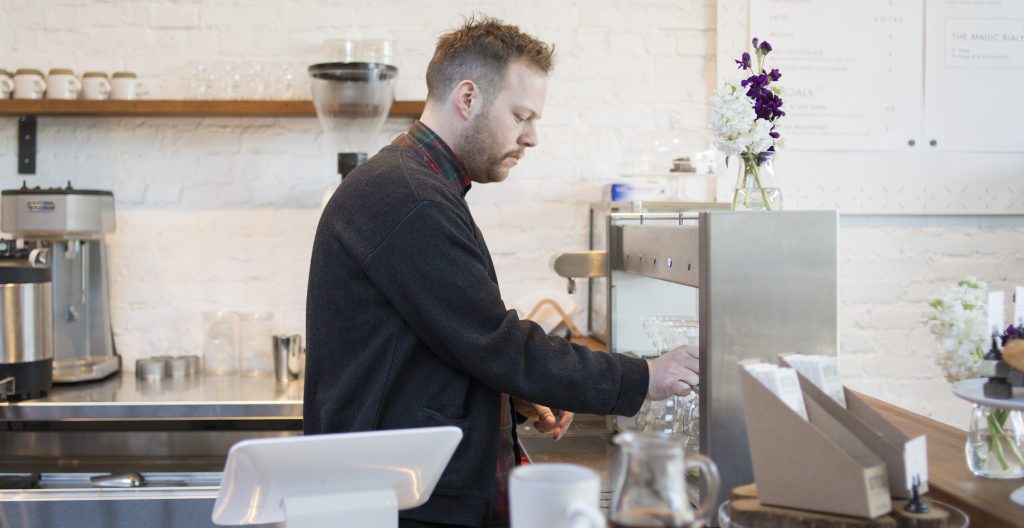
Our solution is a machine called the Poursteady which is produced by a couple of engineers in Brooklyn who handmake each machine in their shop (www.poursteady.com). The machine is app-controlled, allowing to set water temperature, flow rate, and nozzle pattern to ensure the precision and repeatability required for the best flavor development of each roast we serve.

The machine allows one barista to accurately brew up five drinks at once, which would simply be impossible if done manually. The machine, thus, frees up baristas from tending to five cups sequentially to catering to customers and offering and selling pastries, coffee beans and other products. As such, while the high machine costs are high, they are quickly recouped given the savings in labor cost. This is particularly the case for Portland, Oregon which has a high minimum wage.

Success story

We have our work cut out for us, as many Portlanders are unfamiliar with the pour-over method, assuming that it is “just black coffee” no different than a batch brew, which can be found nearly everywhere at a lower price point. This means that staff has to “sell” every customer on the pour-over method by informing them of the superior quality of the product. By now word of the pour-over method has spread and several new customers are already familiar with the process and advantage of pour over coffee and are thrilled to finally have an option in Portland.

I believe that the shop opened in time to capture an underserved market. The machine itself is an attraction as well that fascinates some of our customers.

Company and contact info

Jory Coffee Co.

Jorian Merrill, Owner

3845 N Mississippi Ave, Portland, OR 97227, USA

480-369-4712

support@jorycoffee.com 

Bringing Automation to Specialty Coffee Read More »

We use cookies to give you the best online experience. By agreeing you accept the use of cookies in accordance with our cookie policy.

Privacy Settings saved!
Privacy Settings

When you visit any web site, it may store or retrieve information on your browser, mostly in the form of cookies. Control your personal Cookie Services here.

These cookies are necessary for the website to function and cannot be switched off in our systems.

In order to use this website we use the following technically required cookies
  • wordpress_test_cookie
  • wordpress_logged_in_
  • wordpress_sec

Decline all services
Accept all Services