social sustainability

AIRTH’s take on 2020 travel trends

Every year different marketing agencies and consultancy companies compete with their predictions about the most significant trends for the coming year. This year, being also the beginning of a new decade, such lists are ever more prominent. So, to start an innovation-fuelled 2020, AIRTHers put their heads together in late December 2019 and early January 2020 and prepared our selection of top 5 trends that we believe will leave a mark in the travel industry of the 2020s. These include:
 
– Secondary cities: the interest in unknown destinations is growing. With over-tourism suffocating iconic destinations such as Venice, Barcelona, and Amsterdam, many travelers are more than ever willing to explore the “second-tier” destinations, even more so if visiting such cities contributes to the wellbeing of the locals and thus allows tourists to feel feel that they are the drivers of sustainable tourism change.
 
– Slow-motion: instead of looking for efficiency that dominates our working lives, many travelers will decide to take longer and more scenic routes to their destinations. This means preferring the “old-school” yet now also “sustainable” means of transport such as trains, boats, and even their own feet.
 
– Gastro-centric: you scroll your social media, get attracted by a particular dish that stimulates your imagination, and figure out who the chef behind it is. Next thing, you research where their restaurant is located, get a table confirmed in some months’ time, and bang there you go – this will be your next trip. Sounds familiar? Indeed it is one of highly likely travel scenarios of 2020s.
 
– Like a local: days when travelers just wanted to see the main sights of the destination are long gone. Now travel is about experiencing authentic places, sipping coffee in the hidden neighborhood cafes, and buying seasonal local produce from the small farmers’ markets that were up until now some of the best-kept secrets of local residents. Experiencing local culture and people watching are a must.
 
– Solo travel: a steeply growing segment, not only single millennials but even people above 45 in functional relationships, is pursuing solo travel to focus on particular interests. Tempting the solo traveler with an attractive and fairly-priced offer will become one of the big topics in travel marketing.

AIRTH’s take on 2020 travel trends Read More »

AIRTH’s take on 2021 signs of change

Miha BratecDejan KrižajJaka GodejšaTadej Rogelja – AIRTH & University of Primorska, Faculty of Tourism Studies, Turistica 


Introduction
 
While most people would agree that 2020 was the worst year in the modern history of tourism, and looking at the sheer numbers would confirm these claims, we at AIRTH will try to look beyond the obvious and offer a more balanced view of the lessons and trends that this pandemic helped triggering:
 

1. Overtourism is stopped and there is a real opportunity for sustainable change.

2. The high-spending, price-insensitive business segment is gone.

3. Flexible booking conditions are the (new) norm.

4. Consumer-centric services are needed more than ever.

5. Forced technology adoption is just the beginning of digital transformation.

6. Local and domestic tourism is the more resilient one.

7. Regenerative/transformative travel is up-and-coming.

 
Let’s start with the positive!
 
1. Overtourism is stopped and there is a real opportunity for sustainable change.
 
We would even dare say – overtourism is gone! At least for the unforeseeable future. 
 
Strolling along the promenade of the seaside town of Koper (Slovenia) this spring, one would often hear a passing couple say, “Look, what a crowd!”. But in reality, there were only five people approaching from the opposite direction …
 
This suggests that the perception of crowds and masses changed in people’s minds during the pandemic and is likely to continue to do so in the future. For instance, where  crowds once used to be 100 people, now even five people are considered as such. All of this is also slowly seeping into people’s subconsciousness as the media tells us at every turn there should be “no crowds, no gatherings, no masses, you’re grounded etc.”.
 
Though it started as a temporary, pandemic-induced security measure, the trend of social distancing will continue, as various tourism stakeholders have become fed up with crowds, overtourism, and all the inconveniences they conjure. People are therefore looking for more sustainable forms of travel and visitor flow management.
 
The pandemic gave us a chance to reconsider and observe how a world that we longed for would look like in practice. For example, (1) when Venice briefly reopened in the summer of 2020, fish swimming in clear canals and a more peaceful atmosphere were just some of the perceived benefits. (2) In the first half of 2020, CO2 emissions fell by 8.8% compared to the same period in 2019, which is even greater than their decline during the 2008 financial crisis and the 1970s oil crisis (Potsdam Institute for Climate Impact Research – PIK).
 
Other trend forecasts found in the media and research reports clearly show that types of tourism involving large gatherings (group-based) will most likely be in decline (school trips, cruises, religious tourism, group travel, mega-events, MICE tourism, shopping, etc.). In contrast, nature and wildlife are expected to triumph. The hills, seaside resorts, wildlife reserves and somewhat remote and isolated places will win over the crowded destinations. Road trips will become more popular (RVs, cars, bikes of all kinds, …).
 
Most want to slow down or pursue either long forgotten or banned passions, so biking vacations, sailing, walking, hiking, fishing, etc. will re-emerge as reasons to vacation. Health farms, spas, nature villages, etc. are newer options to branch out to.
 
2. The high-spending, price-insensitive business segment is gone.
 
Now we come to the more negative aspects of COVID. The most affected form of tourism, which will also require the longest recovery time, is undoubtedly business travel, especially conventions. Unfortunately, this segment has also been the most lucrative one for all those involved in tourism, as it tends to be price-insensitive and yields the highest spending. 
 
In fact, it is doubtful that this segment will ever return to pre-COVID levels. Why? Simply because the entire business world has realized that (once not so attractive) online meetings can be just as productive as face-to-face meetings, and you don’t have to fly halfway across the continent just to attend a conference or a simple partner meeting. 
 
Business, aside from tourism, wasn’t truly affected when travel stopped and lockdowns occurred. So why should business travel be deemed necessary again, now that we have learned how to efficiently conduct (most of our) business and negotiations online? However, since humans are social creatures and we still enjoy being with colleagues and partners while also seeing an occasional trip as a business reward, we expect the recovery of incentive-driven travel to occur and resume much more quickly once health concerns become better manageable and meetings in public spaces are an option again. 
 
Ultimately, the road to recovery in all sectors is long and winding, and for now, tourism managers should innovate by either (1) entering the growing online service ecosystem or (2) repurposing physical facilities by, for example, focusing on leisure segments that will recover more quickly whilst converting conference rooms into retail outlets, thus making places more attractive for vacation and relaxation rather than (just) workshops and training.
 
3. Flexible booking conditions are the (new) norm.
 
In times of great uncertainty, when situations and constraints change daily, travellers need full flexibility. Full stop. And so flexible booking conditions that allow for cancellations and last-minute changes are the new norm. 
 
Unfortunately, this means that already cash-flow-strapped tourism suppliers have little opportunity to generate upfront and guaranteed sales, as these would further negatively impact the already low demand. Labour costs for reservation departments are rising, but there seems to be no solution in sight until times properly settle down. 
 
Even then, will advance purchases and non-flexible fares that were the norm for anyone looking for good value travel deals, be accepted by the customers once again? We’re betting on yes, but the differences between flexible terms and non-refundable deals will have to be more pronounced than in the past. Long story short, say goodbye to guaranteed sales for now and say hello to being forced to offer steep discounts when the time finally comes to reintroduce them.
 
4. Consumer-centric services are needed more than ever.
 
In a time when our daily lives are governed by strict hygiene protocols and every entry into public spaces requires us to change our usual behaviour by following prescribed guidelines, the carefree holiday feeling is often hard to find. This makes it all the more important that the tourist service providers, even if camouflaged and after millions of security measures that they can hardly get their hands on, increase their gestures of hospitality and a warm welcome to the maximum. 
 
Guests had a lot to overcome before they could travel, and the last thing they need once they arrive at their destination is a kind of “military treatment” by their hosts, who try so hard to follow the newly imposed safety rules and recommendations that they forget that they are there first and foremost to meet the guests’ needs and even pre-anticipate them. In times when safety is an additional, but by no means the only factor in the discussion about perceived service quality in tourism, it is more important than ever for tourism businesses to think consumer-oriented and tailor their services to the individual guest.
 
5. Forced technology adoption is just the beginning of digital transformation.
 
OK. We’ve all read about the massive changes COVID has brought to tourism and hospitality businesses when it comes to adopting new technologies. While it has certainly accelerated the processes of digital transformation, which the sector has traditionally been highly sceptical of, those of us with a little knowledge of tourism and technology may also roll an eye or two. 
 
In truth, the vast majority of the industry has only adopted solutions that have been around for over 10 years, such as contactless check-in and QR-coded digital menus. But have the industry’s business models properly evolved to thoroughly embrace the new possibilities enabled by cutting-edge technology?
 
 
Not really, most QR codes lead us to PDF menus that provide lists with dishes and their prices that are  just as static as their paper counterparts before March 2020. For us, the innovators and business model geeks, true digital transformation will not begin until the QR codes lead us to menus that incorporate at least some form of dynamic UX and business model engineering. For instance, by introducing Dynamic Pricing as the first steps to implement the principles of Revenue Management not only in the airline and hotel sector but also among food and beverage outlets.
 
6. Local and domestic tourism is the more resilient one.
 
In recent decades, international tourism has been lauded as “the good”, “the rich”, “the economically viable”. A weekend in London, season-opening in Ibiza, main summer holiday on the French Riviera, a hike or two in the Austrian Alps, end of summer on Mykonos and an autumn trip to Morocco or Israel to catch a few last splashed of summer and prolong the tan for the winter – a typical scenario of many European urban middle classes. 
 
As travel and mobility became part of the weekly work routine, flying abroad became as common as taking the subway or train to work, and vacationing in one’s own country was something completely passé, something reserved only for the “boring, older and/or unfashionable” crowd. And then comes 2020, and staycations and holidays “at home” become the norm for most. 
 
People discover the beauty of the places that surround them, where they never bothered to go before, and suddenly domestic tourism becomes sexy again. Not just sexy, economists are quick to note, because while it’s not as lucrative as international, it’s the one which is much more resilient. And environmentalists are overjoyed at finally being heard. And yes, countries that have invested decades and millions in strategies to focus on international markets are suddenly in big trouble and beginning to rethink … and wonder where it all went wrong.
 
7. Regenerative/transformative travel is up-and-coming.
 
After months of the dreary and monotonous lifestyle we have been experiencing, we predict that people will try to take charge of life again. From being passive observers of the crisis our society went through and is still going through, to actively engaging with the world. The pandemic has disconnected people from the things that matter most – relationships, experiences and communities. Travellers in 2021 will strive more than ever to connect with locals, to experience something new that will have a lasting impact on their lives while contributing to the local communities they travel to. 
 
For each individual, transformative travel can be something different. One of the examples could be to immerse yourself in the culture and engage with the locals – you could learn how to bake the traditional Slovenian pastry potica from a local. And for more potentially transformative and certainly regenerative experiences, like the ones that AIRTH mentors thrive from, visit www.localsfromzero.org
 

That’s it!

To sum up: Let’s not go over the limit again, let’s stay flexible, people-centred, innovative, transformative and regenerative!

HOW TO CITE:


Bratec M., Krizaj D., Godejsa J. & Rogelja T. (2021). AIRTH’s take on 2021 signs of change. In AIRTH Encyclopedia of Innovation in Tourism and Hospitality. Retrieved: <insert-date>, from http://www.airth.global


AIRTH’s take on 2021 signs of change Read More »

Connected-community hotel

Introduction

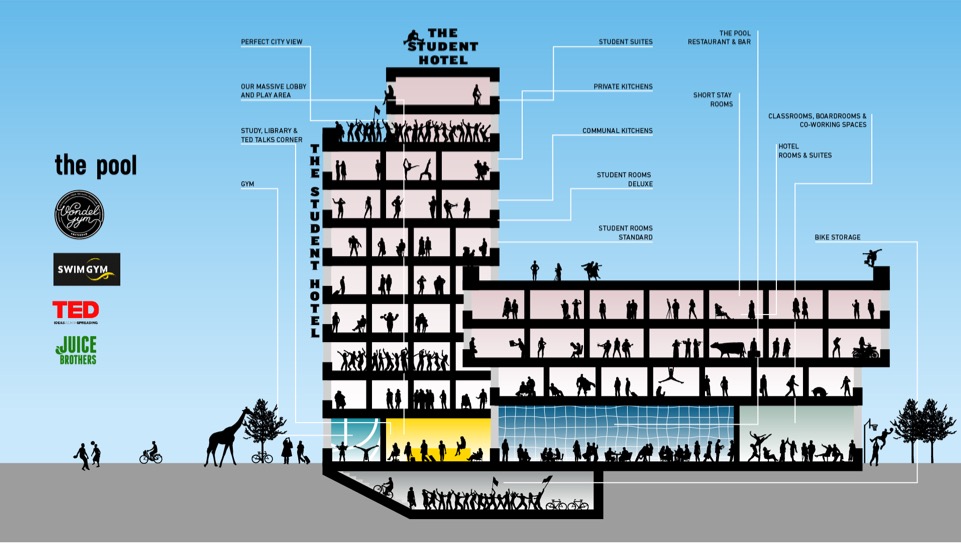
The Student Hotel claims it is the world’s largest “complete connected community”. It is comprised of individuals inspired by the student spirit who co-work, co-live and “co-a-lot-more.” Each hotel is a place where long-term student residents as well as hotel guests experience hybrid accommodation that blends living with leisure and work facilities. With a vision of bringing people together, The Student Hotel is intended to encourage individual goals to be achieved while guests collectively work to change the world for the better.

Description of the destination or original product

Collaboration and design are two cornerstones of The Student Hotel. The hotels’ vibrant atmospheres are designed as modern, open spaces in order to forge new connections between guests and to cultivate collaboration and idea sharing. Four demographics are served at The Student Hotel: student guests, hotel guests, short-stay guests (those staying from two weeks to one year), and those who use the premises to work and meet.

State-of-the-art facilities as well as high-speed Wi-Fi are only some of the ways in which guests’ experiences are maximized. At each of its thirteen current locations (including Amsterdam, Barcelona, Berlin, Florence, and Paris), The Student Hotel contains student rooms, hotel rooms, and co-living studios. The ground floors host open spaces to facilitate social and inviting environments. They are publicly accessible and include study areas and meeting rooms. Hotels are equipped with facilities such as a gym, swimming pool, game room, bar and fleet of bicycles that can be used by The Student Hotel community. In seven of the current locations, entrepreneurs and businessowners can become members of the TSH Collab, which is a co-working space that offers desks, office space, and meeting rooms and events on demand. Members have access to all TSH Collabs, meaning that they are able to take their work with them wherever they go.

The Student Hotel connects people of various backgrounds, whether students, entrepreneurs, or travelers. Each person contributes to the connected community, and the overall result is cross-cultural understanding. While students enjoy high-quality accommodations, parents are able to visit as hotel guests and enjoy the inclusive environment. With the inception of The Student Hotel concept, the socially-minded design of a hotel has successfully contributed to the spirit of discovery, openness, and adventure.

Process that facilitated change

CEO Charlie MacGregor was involved in the student accommodation industry before creating The Student Hotel. His plan was not originally to create a hotel akin to what The Student Hotel is, but rather to provide first-year students with good quality accommodations, ample shared common spaces, and extensive ground floors where individuals could come together.

Once the business plan evolved into a hotel model, it became evident that The Student Hotel environment was one in which people of all generations and backgrounds could be successfully integrated in order to bring the community together.

Implementation

The first branch of The Student Hotel was established in Amsterdam. Since then, the company has expanded in the Netherlands and abroad. With the help of public-private partnerships with local as well as international stakeholders, The Student Hotel has grown substantially. With the help of city governments and property companies, buildings that remain vacant have been successfully developed into hotels, sometimes in less than a year. All efforts in the planning and development process are done with the support of international experts.

On March 3, 2017, the first TSH Collab was opened in Amsterdam City, the company’s flagship hotel. Since then, TSH Collab (as well as hotel locations) have begun to spread throughout Europe.

To encourage meaningful change-making, The Student Hotel aims to utilize ten percent of its resources and space to creating a positive impact on the world. This process has been accomplished by the greening of buildings and supporting a diverse community, to name a few. Through its annual Impact Report, The Student Hotel discusses its current sustainability initiatives.

Success/failure story

Forty-one hotels are slated to open by 2021. In total, these hotels will house over 3,000 bikes, 1,755 hotel rooms, and 30,000 square meters of shared connecting spaces, and over 1,300 jobs will have been created. By 2020, there will be thirty TSH Collabs in Europe.

The Student Hotel has been able to achieve an accommodation environment that serves students better, integrates parents and guests into the experience, and cultivates a greater sense of community in everyday living quarters.

Company info

The Student Hotel

Jan van Galenstraat 335

Amsterdam, 1061 AZ, Netherlands

www.thestudenthotel.com

References

https://www.youtube.com/watch?time_continue=12&v=saBYrRk1QMw

https://tshcollab.com/en

Connected-community hotel Read More »

Fair(er) home sharing

Introduction

Fairbnb, a startup that is based in Bologna, Italy, is the culmination of the efforts of autonomous groups in different cities that banded together to create a more ethical version toward home sharing. Through a desire to demonstrate that social responsibility can be cultivated in the sharing economy of the tourism market, Fairbnb hopes to inspire the rest of the market to follow suit.

The platform was set to launch in late June 2019 but has been pushed back until mid to late September due to an unforeseen delay in financial resources, which are self-funded by members with the assistance of crowdfunders worldwide.

Description of the destination or original product

Fairbnb allows travelers to legally obtain accommodations from a fair, collectively-owned, and transparent booking platform designed to create meaningful travel and achieve community participation. Through collaboration with municipalities, the platform guarantees that cities can analyze tourism trends and their effects, and it guarantees the legality of rented properties.

Fifty percent of all Fairbnb’s commission is donated to local community projects; locals decide which projects to offer as options, and vacationers opt to fund the project of their choosing, e.g. social housing for residents, community garden funds, etc. Donations to such projects can even be made on the platform without having to book accommodations on the website. Therefore, local communities are also empowered to use the platform as a crowdfunding tool if they so choose.

Local communities are further empowered because residents democratically determine the way in which Fairbnb will operate within their community. Additionally, to limit the negative effects of home-sharing on the housing market of a community, hosts are limited to having only one secondary house listed on Fairbnb.

The co-op is independent, thus ensuring that it is influenced by locals rather than investors. Through a framework of co-ownership and co-governance, decisions are made collaboratively.

Process that led recognition that change was necessary

With the rising popularity of home-sharing platforms such as Airbnb, destinations throughout the world (and especially in Europe) have faced issues relating to mass tourism, which has led to housing crises and other economic phenomena that have negatively impacted locals. Revenues have been redirected from the local economy and toward international organizations, leaving the local population with exceedingly fewer benefits from tourism. Cities such as Venice and Barcelona have suffered the loss of much of their cultural identities, as many locals who cannot compete with the revenues of short-term rental properties have had no choice but to move out of the city centres in the pursuit of affordable housing. Lack of local regulation, aggravated by short-term rentals from speculators who own multiple properties, has only made matters worse. The affordability of rent in touristic areas has been met with consternation, as seen in cities such as Bologna, where students have protested rising rental costs as a result of Airbnb’s presence.

Process that facilitated change

In 2016, the movement to create a home-sharing platform that could serve as an more sustainable alternative to already existing options began. Initially developed by groups from Venice and Amsterdam, where Airbnb and other accommodation options have created considerable issues for local populations, industry experts, activists, coders, researchers, and innovative minds worldwide became involved in what officially came to be known as Fairbnb as of late 2018.

Implementation

Fairbnb is owned and managed by a cooperative of those directly affected by the platform, i.e. users and neighbors, who collaborate with hosts and visitors to create a community-driven experience for all. The model consists of local nodes, which utilizes human interactions as the cornerstone of Fairbnb’s business model. These nodes agree upon sustainability rules that, in addition to local regulations, locals must conform to when listing their properties.

Fairbnb’s test cities were originally in the founders’ cities of residence, but anyone interested in becoming a host is encouraged to pre-register online in order for Fairbnb to become a worldwide phenomenon. To create new nodes, it is required for a small group of locals to initiate the process and for some hosts and social projects to be found.

Success/failure story

Overall, the initiative has been met with approval. In Amsterdam, Barcelona, Bologna, Venice and Valencia, the city administrations have been supportive of Fairbnb’s pilot programs. Local nodes have also been developed in Genova, Helsinki and London as of summer 2019. Still, it will be some time until results better reveal Fairbnb’s impact on the sharing economy.
 
Fairbnb remains a dynamic cooperative program that constantly adjust to changes in accommodation regulations within countries where it holds a presence. For example, as of 1 August 2019, Italy has implemented a new law requiring all tourist accommodations to obtain an identification number through a public register that shall be displayed wherever the accommodation is offered. With changes such as these, Fairbnb is obliged (and enthusiastic) to adapt its platform in order to comply with such regulations and move toward fairer home sharing.

Company info

Fairbnb.coop

Via Alfredo Calzoni, 1, Bologna, Emilia Romagna 40128, IT

T: +39 334 741 4159

E: info@fairbnb.coop

www.facebook.com/pg/Fairbnbcoop

fairbnb.coop

@FairBnB_coop

References

https://fairbnb.coop

https://www.forbes.com/sites/annalisagirardi/2019/03/21/fairbnb-the-ethical-home-sharing-alternative-that-wants-to-undermine-mass-tourism/#57deaf0c3878

Fair(er) home sharing Read More »

We use cookies to give you the best online experience. By agreeing you accept the use of cookies in accordance with our cookie policy.

Privacy Settings saved!
Privacy Settings

When you visit any web site, it may store or retrieve information on your browser, mostly in the form of cookies. Control your personal Cookie Services here.

These cookies are necessary for the website to function and cannot be switched off in our systems.

In order to use this website we use the following technically required cookies
  • wordpress_test_cookie
  • wordpress_logged_in_
  • wordpress_sec

Decline all services
Accept all Services