Japan

Robot-assisted low-cost hotel

Henn na Hotel Huis Ten Bosch: The Road to Low-Cost Hotels (LCHs)

Hisashi Masuda, Kyoto University [i]

Kotaro Nakamura, Japan Advanced Institute of Science and Technology

Introduction

Henn na Hotel Huis Ten Bosch is a hotel project by Huis Ten Bosch Co., Ltd., with the goal of creating a low-cost hotel (LCH). The hotel project began in late 2012. Since the company opened the hotel in July 2015, they have conducted many substantial experiments in the business. As of February 2018, the LCH business is expanding its market. According to Takeyoshi Oe, the General Manager of Henn na Hotel Huis Ten Bosch, the important insights gained through the development of an LCH are to cut labor costs by introducing technologies such as robots and automation, provide uniform quality of service to hotel guests by making robots the main staff, and attract the attention of media and hotel guests with technologies that can be seen as entertainment.

Background

In 2010, H.I.S. Co., Ltd., a major travel agency in Japan, committed to managing the reconstruction of Huis Ten Bosch Co., Ltd. The company, located in a rural area in Kyushu, operates a theme park that emulates a Dutch streetscape. Hideo Sawada, the head of H.I.S. Co., Ltd. became the head of Huis Ten Bosch Co., Ltd. in 2010 and reformed the business in diverse ways. A typical problem in Japanese rural areas is the labor shortage caused by the concentration of young people in urban areas. When Sawada stayed at Hotel Europe, which is Huis Ten Bosch’s official hotel in the park, he noticed many services in the hotel that are costly, such as the presence of a doorman. At this point, he came up with the idea to create low-cost hotels (LCHs) to complement the conventional hotels, similar to the role of low-cost carriers (LCCs) in the airline industry.

Prototyping and Construction

To successfully create LCHs, a project was launched to reduce the labor and utility costs of Huis Ten Bosch’s official park hotels as much as possible by using what were considered cutting-edge technologies at the time. However, building such a hotel facility immediately has high risk. For this reason, the company conducted an experiment in 2013 to build and test a house-type facility called a smart house. Sawada decided to actually live in the smart house for a month to judge whether a low-cost hotel service is worth providing to his customers on the basis of the smart house experiment. In November 2014, the construction of the East Arm, which is the primary building and has 72 guest rooms, began. After that, Henn na Hotel Huis Ten Bosch was opened in July 2015.

Details of Opening a Low-cost Hotel

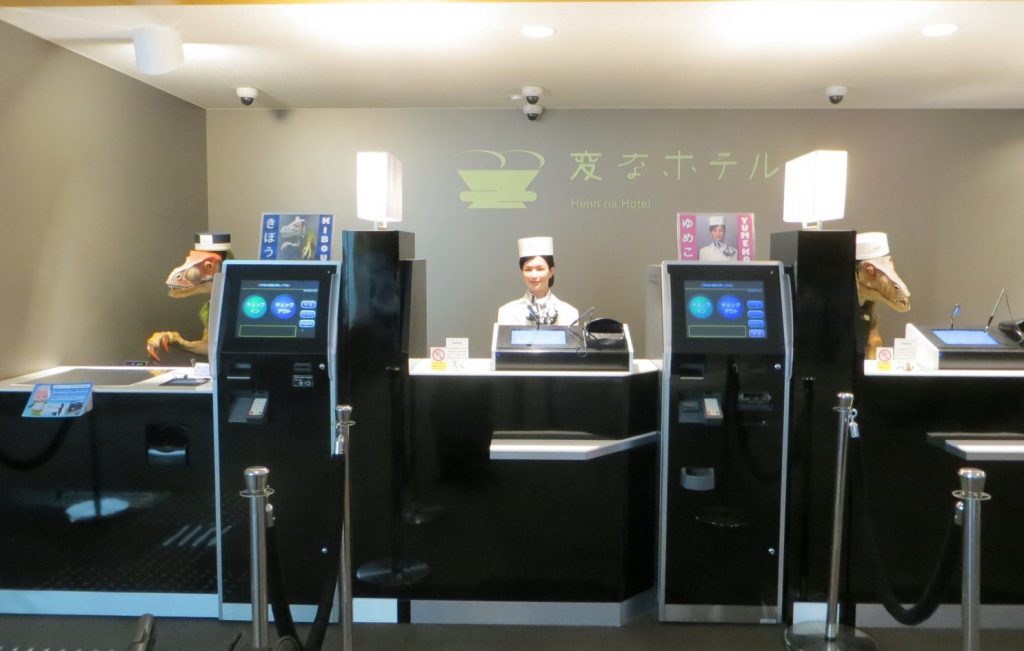
The notable processes to create the LCH in Huis Ten Bosch were: giving it a unique name, introducing cutting-edge technologies to the hotel business, and improving it through trial and error. Regarding the first point, the name “Henn na Hotel” was chosen through a top-down decision. The company chose this Japanese name with a meaning of “a commitment to evolution.” The Japanese adjective “henn na” also has the general meaning of “strange.” Regarding the second point, the company attempted to replace the receptionists, bellmen, cloakroom attendants, and cleaning staff in the hotel with robots. To do so, they first tried to make appointments with companies that seemed to have the capability to make the robots they wanted. However, in the start-up stage of the project, it was difficult to arrange this sort of appointment due to the unique name. The company narrowly succeeded in contracting with several suitable companies. Finally, they also tried introducing new and unique approaches in the actual hotel business in order to reduce the labor and utility costs. For example, the company put two robots in the reception area. One was an android robot with a woman appearance, the other was a zooid robot with a dinosaur appearance, particularly designed for amusement, giving the nod to the hotel’s theme park location. In the guest rooms, there were no TVs or refrigerators, but there was a voice-activated companion robot, which was the first step to replacing a hotel concierge with a robot. For the hotel booking, they implemented an auction system. However, in July of 2015, which was the opening month of the hotel, their guests strongly complained about the radical cost-cutting, the unique booking system, and the voice-activated robot. The staff of the hotel modified the business on the basis of the customers’ opinions. For example, they equipped the rooms with TVs and refrigerators, ended the booking auction system, and adjusted the voice-activated robot to serve children. In Henn na Hotel Huis Ten Bosch, the business model was improved on the basis of trial and error.

Characteristics of the “Henn na Hotel” Low-Cost Hotel

As of February 2018, the important insights gained through the diversified approaches to developing the Henn na Hotel Huis Ten Bosch LCH are as follows.

1) Cutting down on labor costs by introducing technologies such as robots.

In the beginning of the business, there were 72 guest rooms and 30 employees. Currently, there are 144 guest rooms and 7 employees thanks to the robots and the automation of the hotel services that they enabled. However, General Manager Oe noted that, taking potential circumstances such as the sudden illness of a customer into consideration, this number of employees is close to the feasible minimum.

2) Providing uniform quality of service to hotel guests by making robots the main staff.

In human-to-human services, the service quality varies depending on the employees’ physical conditions, customers’ attitudes toward the services they receive, differences in customers’ native languages, and so on. If a robot provides service, the service quality is the same for any kind of guest, given adjustments for different languages. Although the service quality itself is average, this sort of robot-provided service is relatively preferred by foreign guests. Additionally, some Japanese guests who do not want to be bothered by human interactions prefer this robot-provided service.

3) Attracting the attention of media and hotel guests with technologies that can be seen as entertainment.

After opening the hotel, many guests stood in line to check in with the dinosaur receptionist robot regardless of the availability of the lady-like  one. During the hotel project’s conception, the project members did not expect the robots to affect customer behavior in this way. Meanwhile, thanks to the aggressive trial and error in its practices and substantiating experiments, Henn na Hotel had many newsworthy events. A variety of media gave the hotel attention and reported on it extensively. The main purpose of Henn na Hotel was to create a LCH. However, the project members also succeeded in attracting a lot of media and guests who looked at the hotel from different perspectives, such as that of entertainment and newsworthiness. Naomi Tomita, the executive advisor and chief technology officer in Huis Ten Bosch Co., Ltd., calls this sort of business model that is based on substantiating experiments “agility-oriented management.”[ii]

Summary

As of February 2018, the LCH business is expanding into major cities in Japan and other nations in Asia. Looking back on the path to the creation of Henn na Hotel, General Manager Oe explains that the name of the hotel enabled it to overcome a number of failures. “Henn” has two meanings. One is “change,” including the nuance of “evolution.” The other meaning is “strange.” Japanese people who encountered something inconvenient or poorly-managed because of the robot-oriented nature of the facility tended to tolerate it, thinking, “I don’t blame the robots, and besides, the hotel has ‘strange’ in its name.” Agility-oriented management involved in this sort of substantiating experiment runs the risk of providing insufficient service to customers. In a way, Henn na Hotel can be thought to have overcome this risk with its name. The general manager also has plans to develop new hotel and robot services and to continue to explore the “henn na” LCH.

Company Information

Huis Ten Bosch Co., Ltd.

1-1 Huis Ten Bosch-cho, Sasebo, 859-3293

Japan

Tel +81-570-064-110  

Notes


[i] This article is based on an interview with the General Manager of Henn na Hotel Huis Ten Bosch, Takeyoshi Oe (Huis Ten Bosch Co., Ltd.), conducted at Henn na Hotel Huis Ten Bosch on February 23, 2018.

[ii] According to his keynote speech in “Jissen Solution Fair 2018,” held by Otsuka Corporation in Tokyo on February 8, 2018.

Robot-assisted low-cost hotel Read More »
Regional revitalization through contemporary art

“SUZU 2017: Oku-Noto Triennale”: The Road to Regional Revitalization through Contemporary Art

Kotaro NAKAMURA, Japan Advanced Institute of Science and Technology / Soka University

Hideyuki SAKAMOTO, Kanazawa College of Art

Momoka KANO, Oku-Noto Triennale Executive Committee

Introduction

“SUZU 2017: Oku-Noto Triennale” is an art festival aiming for regional revitalization and takes place in Suzu city on the Northern coast of Japan. Oku-Noto is the name of the Northern area of the Noto Peninsula. The organizers of the Triennale formulated an initial business plan (300 million Yen, 30,000 visitors) in 2015. Preparations for the festival have been in full swing since around 2016 and it was held for 50 days from September to October 2017. This is the same period of the conventional fall festival period. The Triennale was a success with 71,260 visitors, a total revenue (including donations) of about 80 million Yen, and an estimated economic effect of 520 million Yen. Additional success indicators are:1,610 volunteers from within and around the city, but also from abroad, participated. Even after the closing of the event, nine artworks were permanently installed and 171 group tours with a total of 5,500 tourists from urban areas visited as of February 2019. The impact on the region has been evaluated, and the festival was decided to be held a second time in Fall of 2020 aiming for 80,000 visitors. This case, as a representative example of tourism-type art events in a remote area, demonstrates that it is beneficial to attract art-mediated customers and to activate regional actors.

Description of the destination or original product

The region is geographically uniquely bounded by the outer harbor to the North and the inner bay to the South. It retains the original historic scenery along the coast and sources of old Japanese culture accumulated over generations. This can be seen in the region’s festivals and rituals, such as festival floats and big lanterns and inviting friends and neighbors to feasts as a social gathering. It also has other rich cultural resources like traditional cuisine, Suzu grilled work pottery and fried beach type of Yantian for salt production. The festival incorporates these resources through art and provides site-specific experience value.

Impetus of change

Suzu city has a rich history of several hundred years with maritime trade and active shipping. However, due to depopulation, it is regarded as one of the most isolated places in Japan. In the past 70 years, the population has halved and the city is faced with an aging society. Therefore, the common sense of wanting to stop the population decline and maintain the sustainability of the area became stronger. One potential avenue to do so is making the area attractive to young people and maintaining the resident. Attention was focused on an art festival to enhance the attractiveness of the area utilizing natural and cultural resources that are not found in sports events.

Process that facilitated change

By welcoming Fram KITAGAWA, who has more than 20 years of experience, as a general director for the festival, the organizers achieved a necessary first step for arts events in remote areas: That is, securing leadership of an artists that a rediscover the charm of the places, patterns of life and engages many area residents and supporters from elsewhere to participate in the art festival (from guidebook ‘writing article). With the aim of “an art festival where traditional culture resonates with contemporary art”, festival organizers aimed for the regional understanding of the art festival and the participation of regional actors.

Implementation

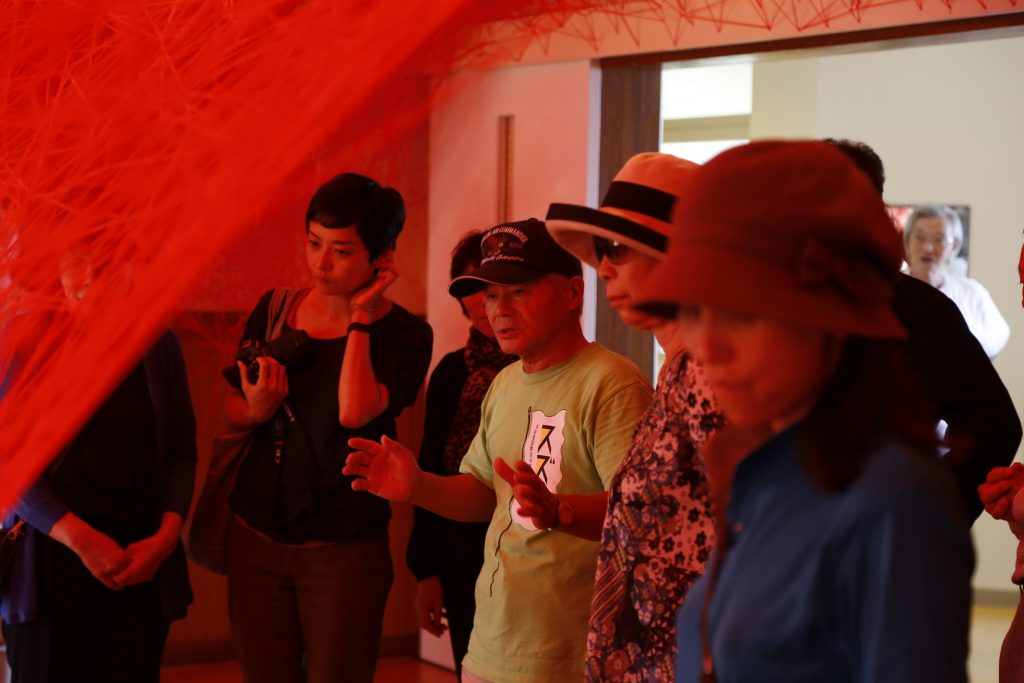
The participating artists were 39 groups from eleven countries and regions (ten groups from abroad, 29 groups from Japan). Initially, the city office led the way by budgeting, prepared the infrastructure maintenance, organized the volunteer, and held explanatory meetings with local district leaders and residents. Through this cooperation of the local community, a regional cooperation system was gradually established through the development of the venue and the creative process of the artworks. As a result, the art installation at the shoreline, the display reusing the inland public hall and old school facilities, the old station building of the “Noto Railway Line” (disused since 2005), the railway track, the ruins of historic commercial houses in the town, unused movie theater etc. It was taken as the work venue.

Typical story

People in the area could hardly conceptualize “the image of how they relate”, except the local district chief who has seen other art festivals after having decided to hold this one. From the time when permanent works and venues (a total of 37 locations) were created, the movement started in each district. There was a working display of deep relationships with life activities such as salt-making places and regional products and embroidery, etc.” “The greater the degree to which people in the area helped,” the more the place was active during the festival period. In addition, the senior generation was trained as guides in the style of talking about the area more than the work. In the last 12 to 18 months before the festival, it became clear that participants took ownership and made the projects they were responsible for ”their own thing”.

Even after the end of the festival, nine artworks remained in place and are now permanent, aiming at the ripple effect such as sightseeing tours to attract more than 5,500 tourists in the first year after the event. In addition, the common sense of “It is necessary to create a scheme including sightseeing and eating and drinking business” is intensifying. The city plans collaboration with key people in marketing, entrepreneurs in the city and with service businesses to create a new organization for the 2020 festival. Transportation and accommodation capacity has also begun to improve and expand. For this purpose, it is necessary to “clarify the economic effect and raise an understanding of the festival among citizens”.

The Triennale has succeeded in attracting contemporary art fans to the Suzu area and made local actors more receptive to events with the help of famous artists’ creative work. Participating local actors are beginning to share awareness and enjoyment of the existence of local resources through art production and appreciation. It is also widely recognized that the region’s diverse resources have the potential to be aware of history and tradition and to deep mutual bonds. If the businesses reflect this in their own tours and brands, it will increase citizens’ acceptability to the city’s’ financial investment as a trigger to create economic value.

Results

The following results can be summarized:

1) More visitors – contemporary art fans.

2) Local people have had an opportunity to rediscover local natural and cultural resources through art events.

3) Local actors were able to raise awareness of future possibilities and potentials of this region.

Organizer info

Oku-Noto Triennale Executive Committee

13-120-1 Iida-machi, Suzu-city, Ishikawa #927-1214

TEL: +81(0)768-82-7720, Mail: info@oku-noto.jp

EXECUTIVE CHAIRMAN: Masuhiro Izumiya (Mayor of Suzu)

DIRECTOR: Fram Kitagawa (Art Director)

CREATIVE DIRECTOR: Katsumi Asaba (Art Director)

References

Oku-Noto Triennale web (http://oku-noto.jp/en/about/ [Accessed: 01-March. 2019])

Kitagawa F. and Oku-Noto Triennale committee office (2017). Oku-Noto Triennale 2017 Formal report: SUZU2017 (http://www.jca.apc.org/gendai/onebook.php?ISBN=978-4-7738-1804-8 [Accessed: 01-March. 2019]).

Kitagawa, F., Breslin, L. & Fravell, A. (2015). Art place Japan: The Echigo-Tsumari Art Triennale and the vision to reconnect art and nature. New York: Princeton Architectural Press.

Notes

This description is based on participant observation during the event, interview with the ONT office people and local collaborators and supporters, and the related publications and newspaper.

Regional revitalization through contemporary art Read More »

We use cookies to give you the best online experience. By agreeing you accept the use of cookies in accordance with our cookie policy.

Privacy Settings saved!
Privacy Settings

When you visit any web site, it may store or retrieve information on your browser, mostly in the form of cookies. Control your personal Cookie Services here.

These cookies are necessary for the website to function and cannot be switched off in our systems.

In order to use this website we use the following technically required cookies
  • wordpress_test_cookie
  • wordpress_logged_in_
  • wordpress_sec

Decline all services
Accept all Services